

The White House signed an executive order on June 2nd titled “Promoting Advanced Artificial Intelligence Innovation and Security,” and the most revealing thing about it isn’t what it mandates, it’s what it doesn’t.
I spent some time yesterday heading back from the Gartner Security & Risk Summit digging into it and wanted to walk through some key takeaways.

The order creates binding requirements for Federal agencies to accelerate AI-enabled cyber defense while keeping every meaningful obligation for the private sector entirely voluntary.
That split tells you everything about the administration’s theory of the case on AI governance, and it raises a question practitioners should be thinking hard about, such as whether voluntary frameworks can hold up against the fast moving threats AI is creating.
That said, as I have written about many times, despite cyber being a market failure, regulation can create its own problems, from perverse incentives, stifling innovation, economic ramifications and more. Safe to say, these aren’t easy challenges to solve regardless of which direction you choose.
I’ve been writing about this tension from several angles over the past year, from the regulation pendulum and AI’s national security reckoning to the AI cyber capability curve that shows frontier model capabilities steepening with every release.
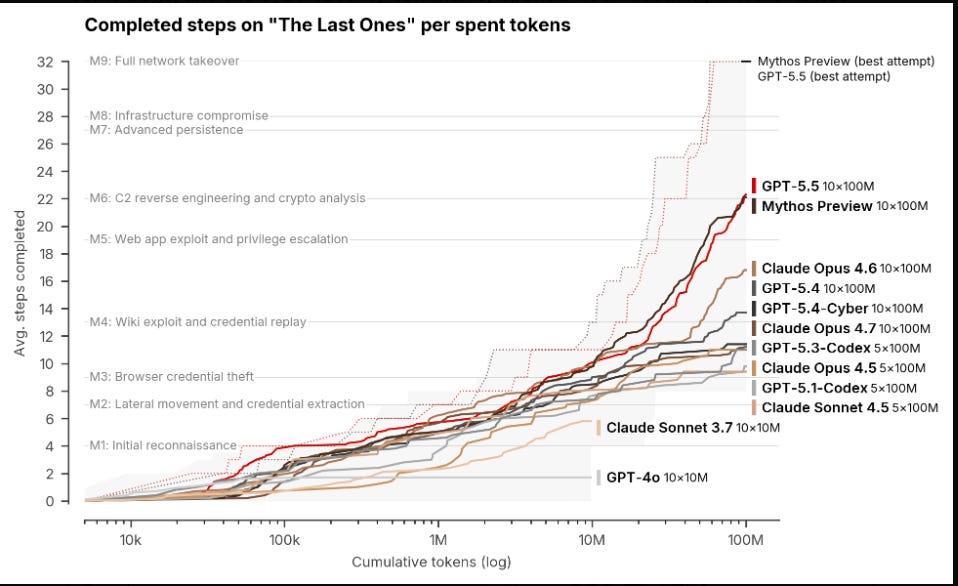
This EO sits at the intersection of those threads.
It’s the administration’s attempt to reconcile a deregulatory posture with the reality that AI capabilities, offensive and defensive, are accelerating faster than the institutions meant to govern them.
What the Order Actually Does
The Federal-facing provisions are concrete and carry real deadlines.
Within 30 days, CISA must release Binding Operational Directives to expedite cyber defense of civilian Federal systems and establish or expand programs that deliver AI-enabled defensive tools.
The Treasury Department, working with NSA and CISA, must stand up an AI cybersecurity clearinghouse to coordinate vulnerability scanning, discovery, validation, and patch distribution.
The Committee on National Security Systems and the Department of Defense must take immediate action to prioritize their own cyber defense postures.
OMB has 30 days to identify Federal grant programs with available funding that can be directed toward AI vulnerability detection.
OPM has 60 days to expand cybersecurity workforce hiring through the Tech Force pipeline, which had onboarded only 10 employees as of late May 2026.
The classified side is notable too.
Within 60 days, NSA must lead a benchmarking process to assess the advanced cyber capabilities of AI models and determine the threshold for designating a “covered frontier model.”
That designation triggers the voluntary framework for the private sector, but the criteria for whaat counts as a frontier model remain classified, with NSA making the final call.
For industry, the operative word throughout the order is “voluntary.”
AI developers can choose to engage with the Federal Government to determine whether their models meet the frontier threshold. They can provide up to 30 days of early access before release to trusted partners, subject to confidentiality and intellectual property protections.
On this note, I think 30 days is a little silly, given we know how long real-world remediation timelines are, for example the latest DBIR shows 43 days as the median to remediate KEV’s, let alone broader vulnerabilities, but if the early access period is too long, it could also impede the commercial ambitions of the frontier labs by delaying their model releases unreasonably.
They can participate in the cybersecurity clearinghouse as well, but none of it is required. The order includes explicit safeguard language stating that nothing:
“shall be construed to authorize the creation of a mandatory governmental licensing, preclearance, or permitting requirement for the development, publication, release, or distribution of new AI models, including frontier models.”
The Deregulatory Logic
This voluntary framing is consistent with the administration’s broader posture on AI.
As I wrote in The Regulation Pendulum and AI’s National Security Reckoning, the current administration has made a deliberate bet that innovation leadership, not regulatory guardrails, is the primary mechanism for maintaining U.S. advantage in AI.
The EO makes this explicit, declaring the policy of the United States is to:
“continue to lead an America First cybersecurity effort that enhances both our national security and our global AI dominance.”
The logic runs something like this when you unpack it.
Mandatory compliance frameworks slow down the companies building the most capable models. Slowing them down means ceding ground to China and other adversaries who face no equivalent regulatory friction. Therefore, keep the requirements on government, keep the private sector engagement collaborative, and trust that market incentives plus national security awareness will drive responsible behavior from the labs.
This is a reasonable framework if you believe the incentive structures between government and frontier labs are sufficiently aligned, and there’s a case to be made that they are, at least for the handful of companies building truly frontier systems.
Anthropic, OpenAI, and Google DeepMind already invest heavily in safety research and red-teaming. The 30-day early access provision isn’t asking them to do something fundamentally different from what they’re already doing internally. It’s asking them to share it with NSA and CISA before public release, giving government defenders preferential access to frontier cyber capabilities.
One big question mark is whether voluntary alignment holds as the ecosystem expands. Right now, frontier models come from a small number of well-capitalized labs with reputational incentives to cooperate.
But the open-weights ecosystem is growing fast, and the economics of AI are driving capability democratization. When smaller labs, open-source projects, and nation-state-backed efforts start producing models that cross the frontier threshold, voluntary frameworks have no mechanism to reach them. The classified benchmarking process can define what counts as a frontier model, but it can’t compel a non-cooperating developer to show up for review.
This is especially notable, as I have shown from teams such as AISLE and what they dub the “Jagged Frontier”, as well as longtime industry leaders such as Niels Provos who both demonstrated in his blog “Finding Zero-Days with Any Model” you can use smaller models, open source, or non-frontier models to find vulnerabilities effectively as well. I’ve also interviewed folks from Mother of All KEV’s (MOAK), who explained how they can autonomously develop exploits in minutes for nearly any CVE. You can catch both interviews below:
The DOJ AI Litigation Task Force adds another dimension to the deregulatory stance.
Within 30 days, DOJ must establish a task force specifically to challenge state AI laws that are inconsistent with the executive order’s federal AI policy. This is a preemption play, designed to prevent a patchwork of state-level AI regulations from creating compliance friction that slows innovation.
Whether you see this as streamlining or as removing necessary guardrails depends entirely on your assessment of whether the voluntary framework is sufficient on its own.
The Threat the EO Is Trying to Meet
The cybersecurity provisions of the order make the most sense when you read them against the backdrop of what AI has already done to the vulnerability and exploitation ecosystem.
The EO directs CISA to expand AI-enabled defensive tools and the Treasury clearinghouse (although many have argued why this resides with Treasury rather than say CISA or NSA) to coordinate vulnerability scanning and remediation at scale, which does seem very odd.
These aren’t abstract aspirations, and instead they’re responses to a threat dynamic that has been accelerating for months and I’ve been doing my best to document through interviews, videos and my own writing.
As I covered in “Claude Mythos - Why It Matters (And Why It Doesn’t)”, Anthropic’s frontier model achieved 73% success on expert-level CTF challenges and discovered thousands of high-severity vulnerabilities across major operating systems and browsers in its first month of operation.
In The Receipts Are In, I detailed how Anthropic’s partners using Claude for security discovered over 10,000 high-and-critical-severity vulnerabilities in a single month, with bug discovery rates up by more than 10x.
The 2026 DBIR confirmed that vulnerability exploitation is now the leading initial access vector, with exploitation timelines compressing while remediation capacity stays flat.
This is the Vulnpocalypse playing out in real time.
AI has industrialized vulnerability discovery and is compressing the window between discovery and weaponization from months to hours, at marginal costs measured in dollars.
The structural asymmetry between the rate at which vulnerabilities are found and the capacity to fix them is widening, not narrowing. And as I explored in The Attack Surface Exponential, GitHub commits are accelerating toward 14 billion in 2026 while AI simultaneously reduces the cost of finding and exploiting flaws in all that new code.
More code, worse code, cheaper exploitation.
The EO’s cybersecurity clearinghouse and AI-enabled defensive programs are direct responses to this dynamic.
The 30-day early access provision for frontier models, when read through this lens, isn’t primarily about regulation. It’s about giving government defenders a temporal advantage over adversaries, a head start on understanding what these models can do offensively before the capabilities become widely available.
That framing is sound but the challenge of course is execution. Remediation capacity and timelines have already lagged vulnerability discovery and disclosure and AI has collapsed exploitation timelines while not yet doing the same for remediation, which just exacerbates the gap even worse.
The Execution Gap
The ambition of the EO’s cybersecurity provisions runs into the same institutional constraints that have limited Federal cybersecurity capacity for years.
CISA is being asked to release Binding Operational Directives within 30 days to modernize civilian Federal cyber defense with AI-enabled tools. But CISA’s budget and staffing have been under pressure, and the agency is being asked to do this for Federal agencies while simultaneously making the same capabilities available to state and local authorities, rural hospitals, community banks, and local utilities. That’s an enormous scope expansion on an aggressive timeline.
The cybersecurity clearinghouse faces a coordination challenge that anyone who has worked in Federal interagency processes will recognize immediately. Getting Treasury, NSA, CISA, the National Cyber Director, and the private sector to coordinate and deconflict vulnerability scanning in 30 days is aspirational at best, and that’s coming from someone who has spent the majority of their career in the DoD and in and around Federal agencies
These agencies operate under different authorities, different classification regimes, and different institutional cultures. The intent is right, but standing up a functional coordination mechanism across those boundaries in a month would be historically unprecedented.
The workforce provisions reveal the gap most starkly.
The OPM directive to expand Tech Force cybersecurity hiring pathways within 60 days sounds promising until you learn the program had onboarded 10 employees as of late May. Scaling from 10 to a meaningful cybersecurity workforce capable of operating AI-enabled defensive tools across the Federal enterprise is a multi-year effort, not a 60-day sprint. This is especially acute given the Federal workforce, including in IT, just underwent massive changes through efforts such as DOGE as well.
The cyber capability curve is steepening with every model release, and the government’s human capital pipeline is still operating at a pace that reflects a pre-AI threat tempo.
The Agent Question
The order’s DOJ provisions on AI agents are worth noting even if they aren’t the centerpiece. The Attorney General is directed to prioritize enforcement of existing criminal statutes, including identity fraud, computer fraud, and wire fraud, against anyone who uses AI agents to unlawfully access data or computer systems. No new criminal authority is created and instead the order sharpens enforcement of laws already on the books.
This is a pragmatic choice because creating new legal frameworks for AI agent liability would take years of congressional action and wouldn’t survive the administration’s own anti-regulatory framing.
Directing DOJ to enforce existing statutes against AI-enabled crime is something the executive branch can do immediately, and it sends a signal to developers and deployers that agent misuse will be prosecuted under current law.
Whether existing fraud and computer crime statutes are adequate for the novel challenges agents create, particularly around autonomy, delegation, and attribution, is a question this order punts to future policymakers.
What will be interesting here is seeing how they determine which attacks involved LLMs and Agents and how, and it will likely require close collaboration with the frontier labs, model providers and CSPs.
What This Means for Practitioners
For security leaders in the private sector, the practical impact of this EO is limited in the near term. Nothing compels industry participation, especially if you aren’t a frontier lab.
The voluntary framework creates an option for frontier labs to engage with government review, but for most enterprises, the meaningful signal is directional rather than operational. The administration is betting on AI as a force multiplier for cyber defense and expects the private sector to make the same bet on its own terms.
As I mentioned above, the real question is whether the voluntary model can keep pace with the threat dynamics it’s trying to address. The Vulnpocalypse isn’t waiting for interagency coordination to mature.
Frontier AI models and even smaller and open source models with effective harness engineering are compressing exploit timelines now, the attack surface is expanding now, and adversaries with access to the same models aren’t participating in voluntary review frameworks.
The EO acknowledges the urgency through its aggressive 30-day and 60-day timelines, but institutional capacity doesn’t bend to executive order deadlines the way policy language does.
What practitioners should be watching is whether the cybersecurity clearinghouse becomes a real coordination mechanism or another interagency structure that exists on paper while the actual work happens bilaterally between individual agencies and labs.
The early access provision for frontier models is genuinely novel and could give defenders an informational edge if implemented well. That said, the gap between the EO’s ambition and the government’s current capacity to absorb and operationalize AI-enabled defensive capabilities is the story underneath the story.
The order gets the direction right, however whether the institutions can execute at the speed the threat demands is the question that will determine whether this EO matters or whether it becomes another aspirational document that reads better than it performed.
Unfortunately, having spent most of my career in the public sector, I fear it will trend towards the former more so than the latter, but I do hope I’m wrong.
For "someone who has spent the majority of their career in the DoD and in and around Federal agencies" you seem to have a glaring blind spot in just what authority the President has when it comes to non governmental entities. Executive Orders do not have the force of law and cannot compel non-governmental groups to comply with these. At best it can allow the federal agencies leeway in how they interact with commercial or other groups.
You seem to get it with this statement "No new criminal authority is created and instead the order sharpens enforcement of laws already on the books." The President doesn't create laws. Federal agency regulations are authorized by legislation, and you clearly point out that's a multi week/month/year effort to get policy action codified into law. (At which point it'll probably be barely applicable or out dated). This would be the only legal method they could force companies or 3rd parties to comply instead of being voluntary.
I share your belief that this is mostly aspirational. But if you don't set aspirational goals you can't stretch to meet them, or change the status quo.
And guess what? Guess who's been priming the pump - just like they primed the pump for the Pope's AI message by sending emissaries to the Vatican long before.
Does anyone really believe Anthropic's primary mission is "AI safety"? Seriously?
Anthropic held cyberthreat briefings with agency CIOs last month
Discussions included how to defend digital assets following the debut of advanced AI models, like Anthropic’s Mythos.
https://www.nextgov.com/artificial-intelligence/2026/06/anthropic-held-cyberthreat-briefings-agency-cios-last-month/413919/