

Google’s Threat Intelligence Group (GTIG) reported on November 16 that:
In the past quarter, it identified threat actors “using LLM frameworks to fully automate vulnerability discovery and exploitation without a human in the loop for the first time.”
GTIG found the framework, dubbed exploit_agent, on an exposed staging server, and says it compares code before and after patch announcements, drafts exploits and “automatically executes them without human intervention.”
That is the other half of a story I’ve been covering all year. Most of 2026 was about AI industrializing vulnerability discovery, which I wrote about in pieces like The Vulnpocalypse Goes GA and The AI Cyber Capability Curve.
Now a new class of tooling is industrializing operations.
Mandiant named it in a report titled “ARTEX and Friends: Enter Agentic Offensive Frameworks,” and I’m going to borrow the term and shorten it to AOFs for the rest of this piece.
Mandiant says the emergence of ARTEX “and similar agentic offensive intrusion frameworks” reflects “a broader shift toward threat actor adoption of open source multi-agent offensive frameworks, as well as potentially custom agentic harnesses.”
ARTEX is the first AOF to go mainstream, but I’m certain it won’t be the last. Capability that once took a nation-state team is becoming something anyone can download and point at a target, and I expect more AOFs and better ones.
In this article, I want to define what an AOF is, walk through how ARTEX went from a GitHub release to an FBI FLASH in roughly sixteen weeks, explain why its successors are coming, and cover what defenders should do about AOFs generally.
So, let’s walk through it!
If you prefer to listen, I made a video on the topic as well:
What an Agentic Offensive Framework Is
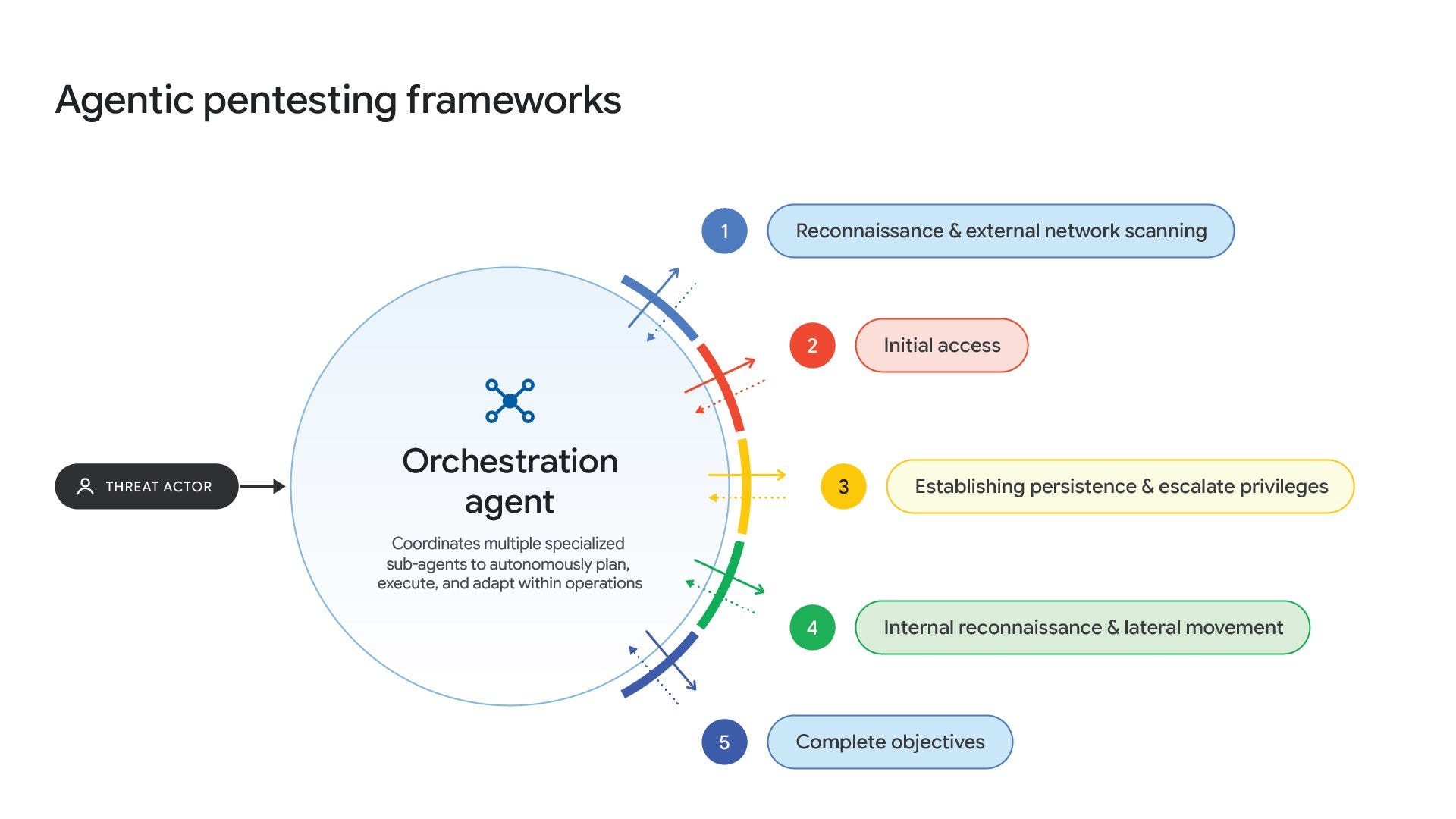
Mandiant doesn’t offer a formal definition, so I’ll lean on Elastic Security Labs, which says an agentic offensive framework “puts a large language model (LLM) in charge of the scanners, curl, shells, and cloud CLIs that red teams and threat actors already use.” A model plans each step, splits the work across agents and builds or installs what it lacks.
GTIG says these frameworks share core capabilities, “discovering and exploiting low-complexity vulnerabilities, using LLMs to generate single-use payloads on-demand, and using real-time execution feedback to dynamically adjust tactics.”
The framework is a harness, and the model is a separate choice. The FBI notes that ARTEX “does not include its own AI model but integrates with external LLM providers,” so operators bring whichever model they like. In an AOF the harness is the capability and the model is a swappable part.
From Finding Bugs to Running Operations
Discovery came first in the major impacts of AI on cyber. In May 2025 Sean Heelan used OpenAI’s o3 to find CVE-2025-37899, a remote zero-day in the Linux kernel’s SMB server, using “no scaffolding, no agentic frameworks, no tool use.” As far as he was aware, it was “the first public discussion of a vulnerability of that nature being found by a LLM.”
Then came Anthropic’s Project Glasswing as a major example of what happens when you turn infinite compute and budget on public code bases. On April 7 Anthropic said its unreleased Claude Mythos Preview could identify and exploit zero-days “in every major operating system and every major web browser when directed by a user to do so.” Its examples included a 27-year-old OpenBSD bug and a 16-year-old FFmpeg bug in a line that automated tools had hit five million times without catching it.
By May 22 Anthropic and about 50 partners had found “more than ten thousand high- or critical-severity vulnerabilities,” and Anthropic wrote that progress used to be limited by how quickly it could find new vulnerabilities and is now limited by “how quickly we can verify, disclose, and patch” them.
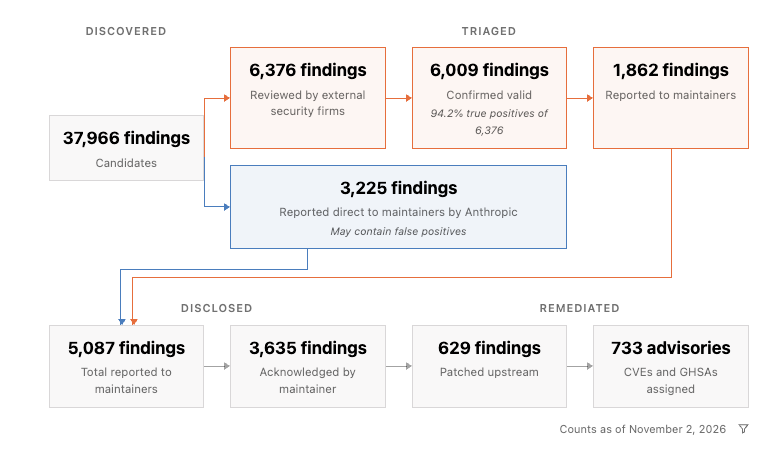
Its disclosure dashboard shows 5,087 vulnerabilities disclosed across 680 open source projects as of November 2, with 629 patched to its knowledge. The Bank for International Settlements asked whether this was a “Mythos moment.”
Heelan then took the next step, building on his earlier research. In January he reported that agents built on Opus 4.5 and GPT-5.2 wrote more than 40 working exploits for a QuickJS zero-day, with an Opus run at his 30 million token limit costing about $30. He notes QuickJS is far simpler than the engines in Chrome and Firefox, and still concludes that the limiting factor for a state or group “is going to be their token throughput over time, and not the number of hackers they employ.”
That is the bridge from discovery to operations, and it is the problem AOFs exist to solve.
Offense also gets there first because it can check its own work. Sergej Epp argues that “Cyber offense has some good verifiers built in,” starting with whether you popped a shell, which is a binary answer. An agent that can tell whether its exploit worked can keep trying until it does, and Cloudflare describes ARTEX and its forks as tools that “turn compromises into a hill-climbable problem, which agents are specifically good at.”
GTIG puts a staircase on this progression, showing the evolution over time. Its timeline marks Stage 5 as the current stage, with multiple attack lifecycle stages run by LLM-driven tooling in the wild and minimal human involvement. Stage 6, attacks with little to no human interaction, is projected in one to three months, and fully autonomous Stage 7 in three to six.
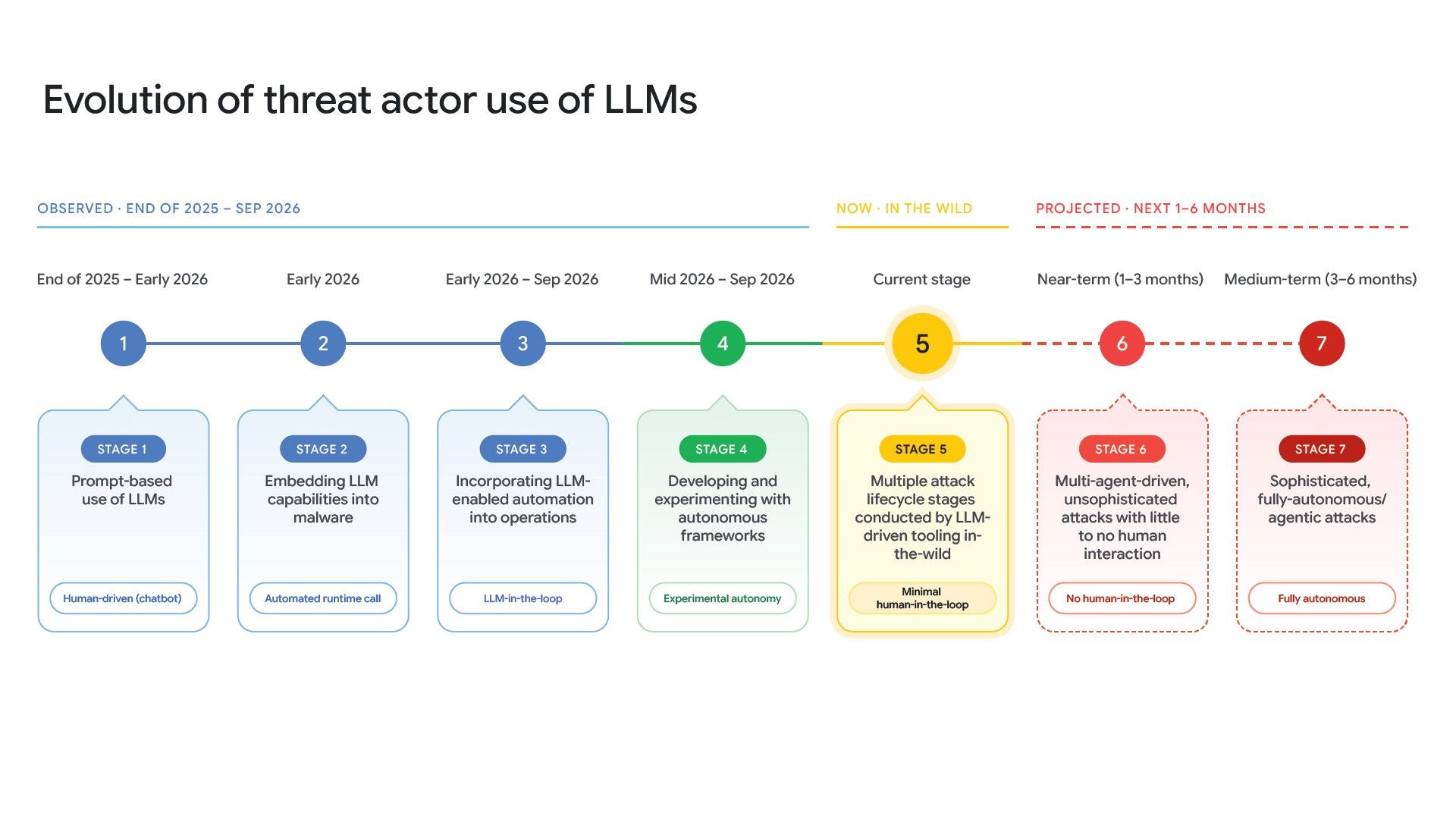
I think Stage 6 is already arriving at the edges, at least for n-day exploitation, since exploit_agent ran from patch diff to executed exploit without a person in the loop.
Sixteen Weeks From GitHub to the FBI
ARTEX is an open-source, multi-agent penetration testing framework with a Go backend and a web console, and GTIG says it abstracts the attack lifecycle across six specialized sub-agents. It was published on GitHub in July, the developer pulled the repository on October 8, and on November 13 the FBI issued a FLASH on it.
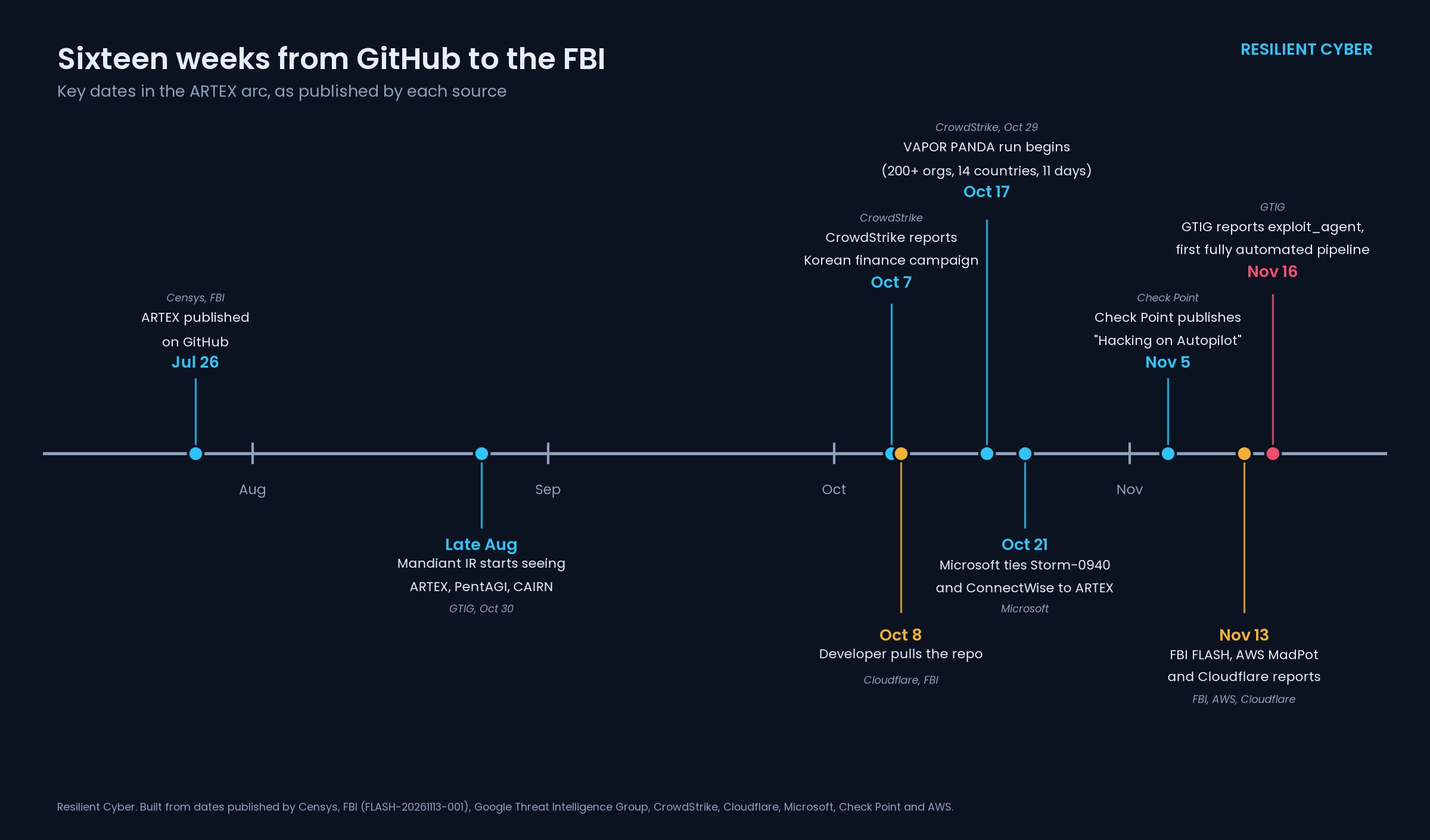
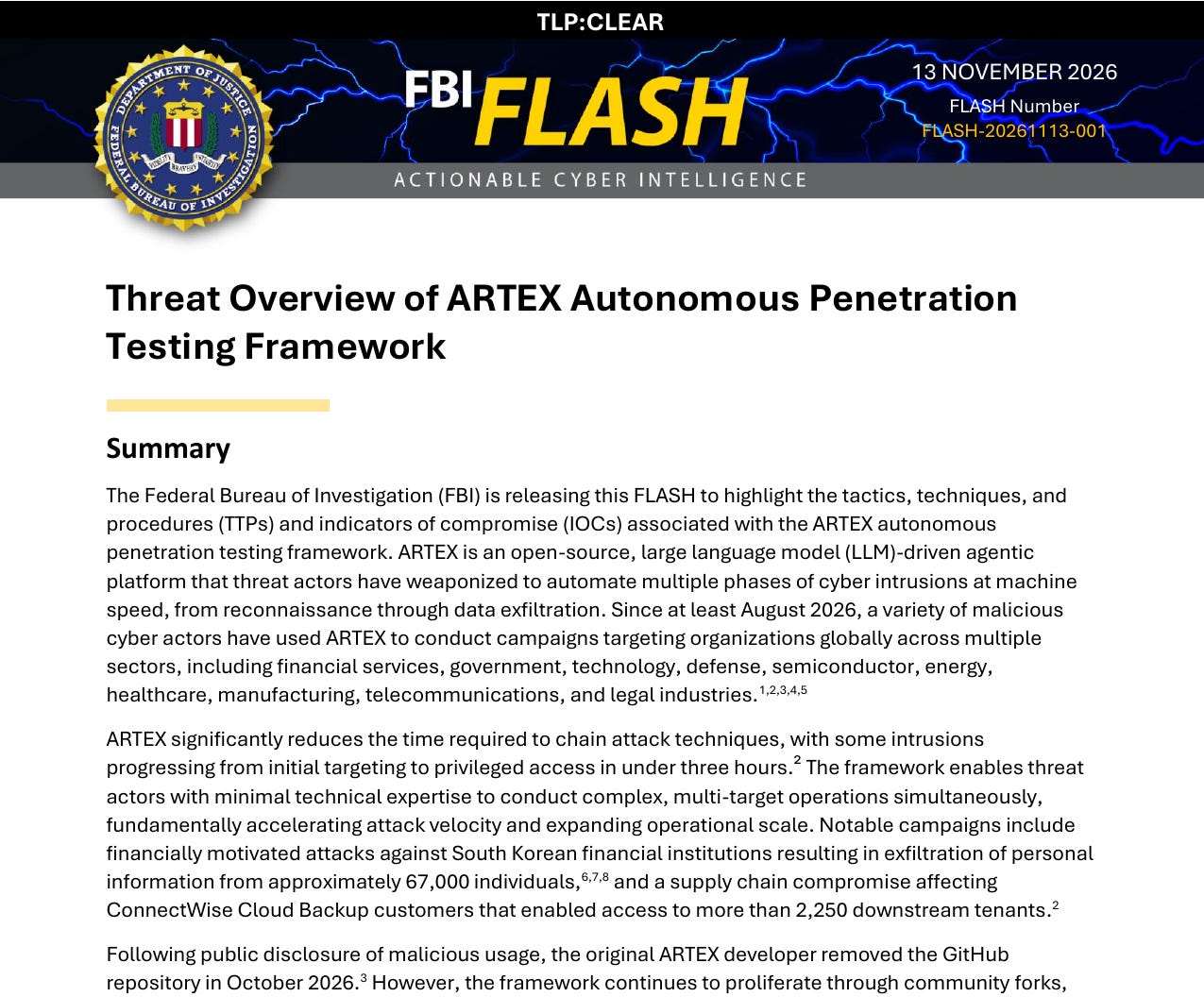
The FBI’s FLASH says threat actors have used ARTEX since at least August 2026 across sectors from financial services to energy. It reports “some intrusions progressing from initial targeting to privileged access in under three hours,” and says the framework “enables threat actors with minimal technical expertise to conduct complex, multi-target operations simultaneously.”
This framing reminded me of Adrian Sanabria, who wrote a piece on how the “script kiddy bar has been lowered.”
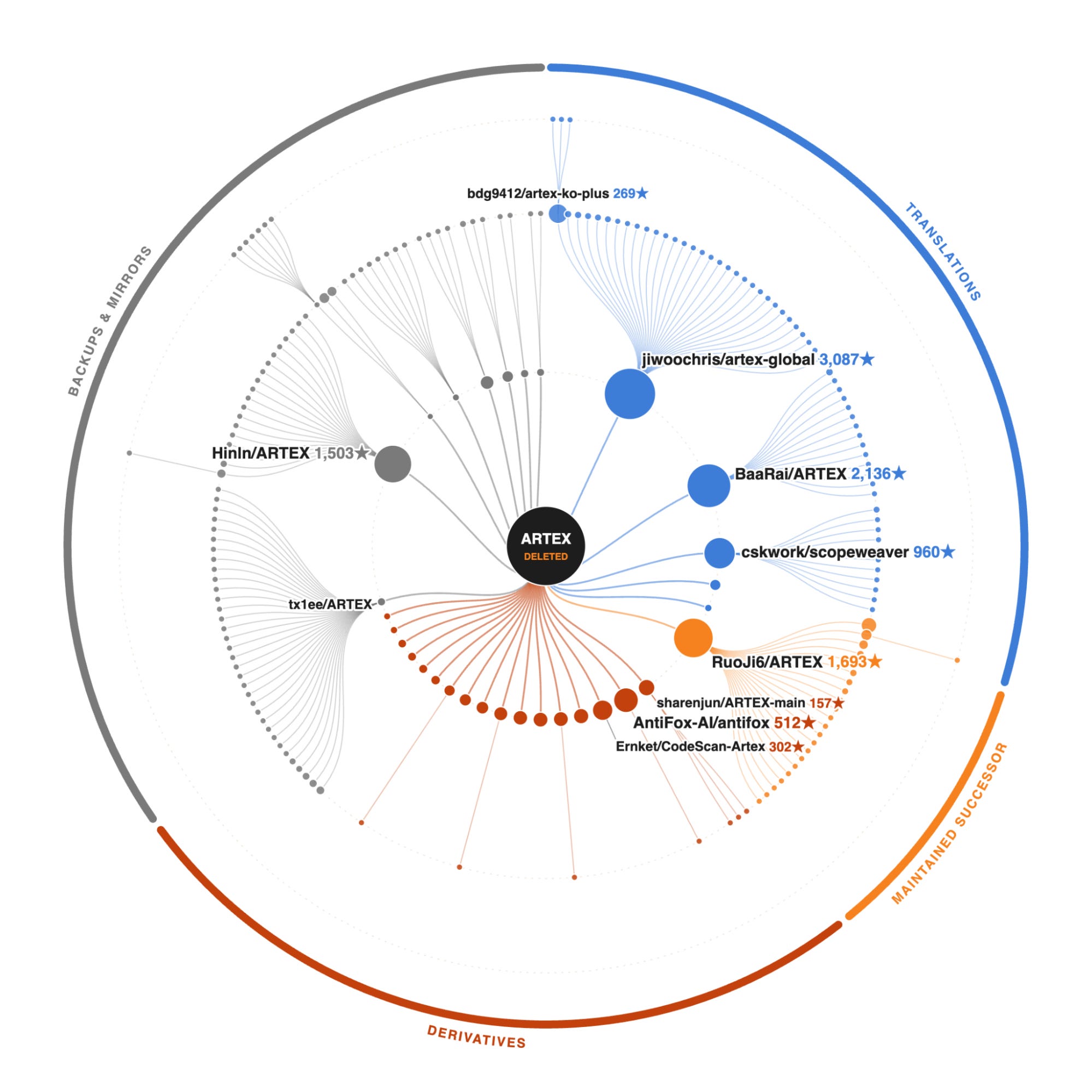
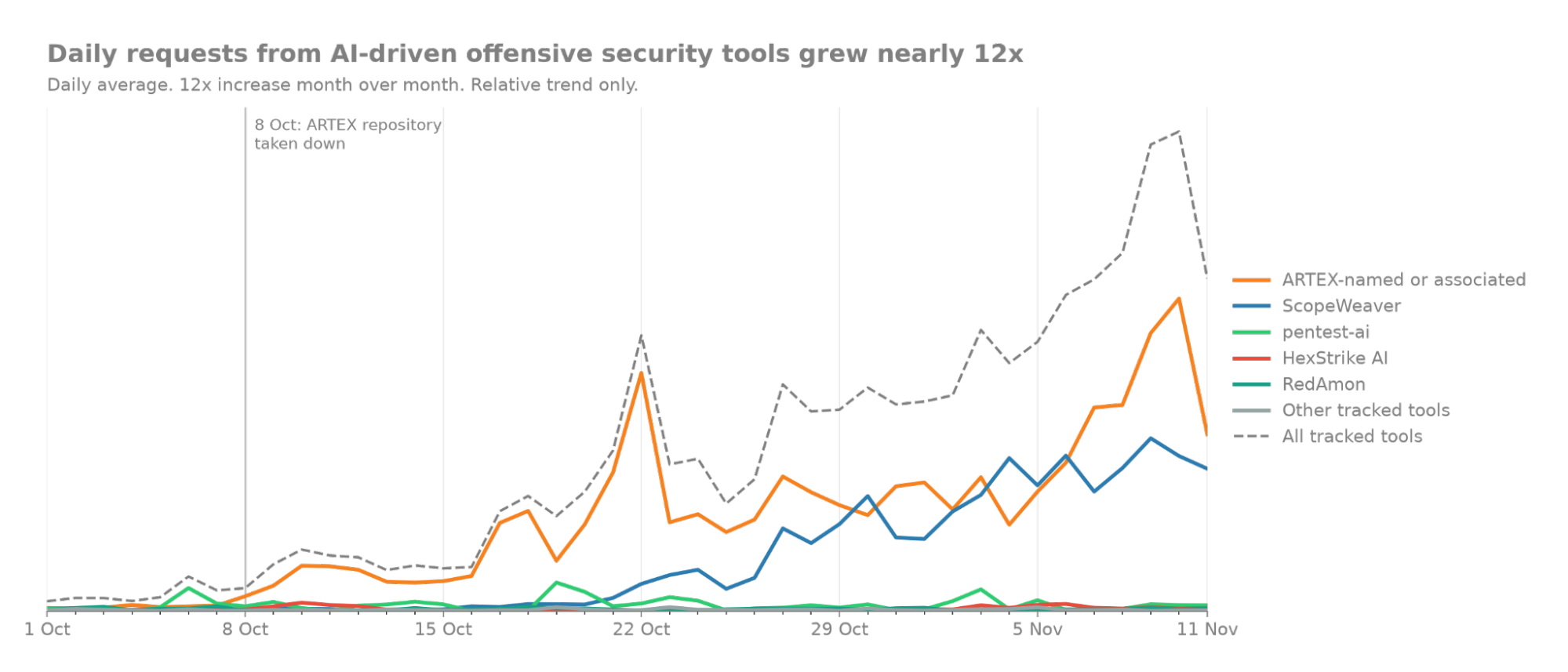
The takedown is the part of this arc I have strong opinions on. I recently said that pulling the repo after the fact doesn’t do much once the code is out. Cloudflare’s data suggests it did worse than nothing.
There are now over 12,000 repositories with lineage from the original, 204 public forks with their own code changes, and ARTEX and its forks make up over 60% of currently known AI penetration testing orchestrators. Traffic from these tools is up more than 30x since October 1 and more than tenfold since the takedown, which Cloudflare says “likely caused a hydra effect.”
This reminds me of how unrealistic I think efforts to stifle open weight models overall would be as well, once the genie is out of the bottle, there’s no putting it back in.
Why ARTEX Won’t Be the Last
ARTEX has already become a family, not a singular framework, tool or moment. It instead represents a systemic change in malicious actor TTPs.
GTIG says the framework continues to proliferate through community forks, including the localized ScopeWeaver and a commercial version dubbed ARTEX PRO, and Cloudflare notes that hundreds of other similar agentic orchestration frameworks have been created since October 8. Cloudflare says “We expect these frameworks to continue to proliferate.”
It also has peers already as well. GTIG has independently observed the open-source CAIRN and PentAGI deployed in the wild and has seen experimentation with CyberStrikeAI and HexStrike AI. CAIRN was used in intrusion activity against targets including the aerospace sector in the US, and CyberStrikeAI connects LLMs to over 100 security tools and YAML attack recipes. Elastic counts more than 60,000 GitHub stars across ARTEX, CyberStrikeAI, Cairn, PentAGI and HexStrike.
GTIG describes PentAGI as designed “to lower technical barriers for entry-level operators running complex campaigns,” and tracked an actor running a customized platform built from its open-source version against organizations in Asia. GTIG cites the “low barrier to entry” in expecting more use.
The next steps are already visible. GTIG has seen evidence that a PRC-nexus group was developing its own automated attack framework, and exploit_agent is a custom multi-agent framework found on an exposed staging server. Mandiant anticipates that stealthy, long-term-access actors are less likely to use the public versions, though they may use them for scale and speed.
GTIG says today’s frameworks “currently trade stealth for velocity,” and that as the tools and underlying LLMs improve, “we anticipate not only reduced human involvement in these operations but also increased stealth and sophistication of the activity.” Read that against the maturity timeline and ARTEX looks like Stage 5 of seven.
I expect later AOFs to be quieter and more autonomous, making them more difficult to detect, as well as more challenging to discern from human malicious actors (although the distinction may also be irrelevant).
If the takedown was meant to slow proliferation, the data says it did the opposite, which should shape how we treat dual-use open-source tooling, and says a lot about any ambitions to stifle open weight AI overall.
What the Incident Record Shows
Most of the record so far is ARTEX, since it went mainstream first, and it shows up at both ends of the capability spectrum. Microsoft reported that Storm-0940, a China-state aligned actor, used ARTEX to attempt sign-ins to more than 2,250 tenants after the ConnectWise Cloud Backup compromise.
CrowdStrike tied a single ARTEX controller to a China-nexus campaign that began October 17 and hit more than 200 organizations in at least 14 countries over 11 days.
At the other end, Seoul police identified a gang whose leader has a penetration testing background and adopted AI tools in late August 2026. Police believe the group breached more than 90 organizations and told Yonhap that:
“Even individuals who are not professional hacker organizations can now hack on a large scale with the help of AI.”
China-nexus operations and a criminal gang were running the same open-source framework within months of its release, which is what a commodity looks like.
The latest entry in that record comes from the European Commission. POLITICO reported on November 19 that a cyberattack that disrupted the Commission’s HR and medical reimbursement systems for more than 10 days involved ARTEX, citing an EU official who said CERT-EU detected that international hackers had used the tool.
The Commission has confirmed the attack, saying it first detected the incident on October 22 and that it was done with AI tools, though the spokespersons remarks as AP reported them did not name ARTEX. The Commission also says it has found no evidence of a data breach affecting staff as a whole, while an EU official told POLITICO that investigators are still working out whether any staff data was compromised.
CERT-EU warned on November 5 that AI-driven activity against EU institutions highly likely involved ARTEX, though neither it nor the Commission has described publicly what role, if any, ARTEX played in this intrusion.
Old Doors, Faster Hands
None of this required a new technique. AWS wrote,
“None of the techniques in these campaigns were new. What AI agents change is the speed and persistence of the attacker.”
The agents succeeded where basic security hygiene was missing, including default or hardcoded credentials, keys left in code and public artifacts, unauthenticated interfaces and inference endpoints, and unpatched software.
This is the security debt collector I keep describing, and it now has a fleet. The debt is the same decades of exposed interfaces, unrotated keys and unpatched systems, and the collector got faster. GTIG notes that overall disclosures and exploits “nearly doubled between January and August 2026.”
What stands out is how much the authorities agree. The FBI, Microsoft, Mandiant, AWS, Cloudflare and CERT-EU land on a similar set of controls, from shrinking internet exposure and killing long-lived secrets to rate limits, error sanitization and behavioral detection. Mandiant calls its own recommendations “long-standing security best practices.”
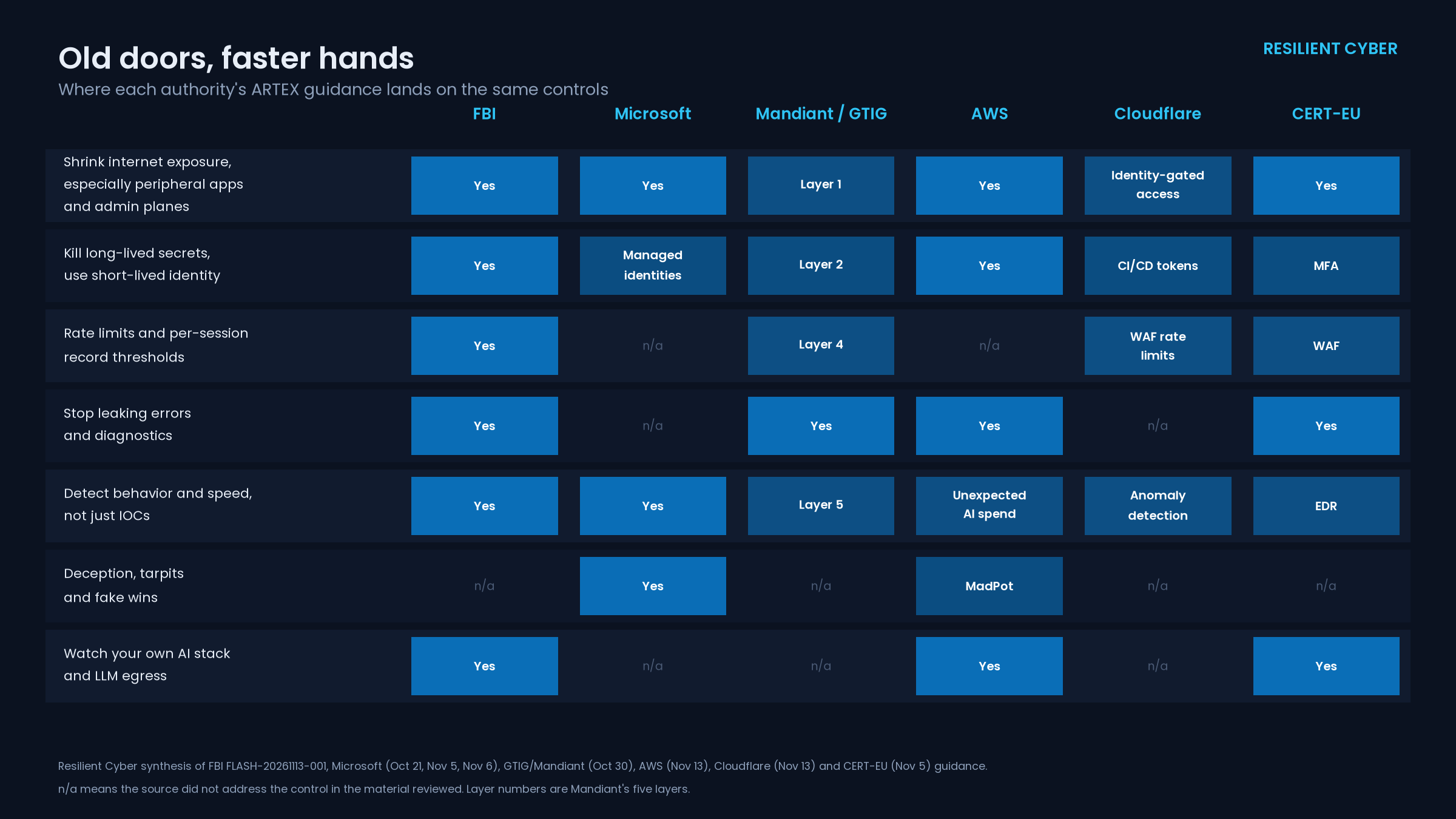
It’s worth noting that the “fixes” are things that have been best practices for years and/or decades and organizations have largely just neglected to prioritize or accomplish.
If everyone agrees on the fixes, the obvious question is why organizations keep failing at them?
My answer is that the work is organizational, meaning someone has to own the forgotten partner portal, approve the credential rotation and fund the cleanup of the legacy system nobody wants to touch, which is the same systemic problem I wrote about in There’s No Bucket Big Enough.
The Skeptics’ Strongest Points
I want to give the skeptics their due as well, because several have credibility and make strong points as well. Marcus Hutchins, who has routinely been a bit of a skeptic around AI’s impact on cyber, and who tracks threat actors for a living, argues that AI use by threat actors is mostly mundane.
In his words, “the overwhelming majority of threat actor AI use is non-transformative,” and “even in the transformative cases, they’re just gaining capabilities to leverage existing attack techniques, which are prevented with existing defenses.”
Daniel Card, after a week of hands-on use, called ARTEX a terrible pentester that is noisy and “burns tokens like CRAZY.” Casey Ellis said that while some of the surge in IR work is actual malicious actors, a lot of it is likely “attributable to stupidity” as people fire ARTEX off into the wild, which doesn’t seem far-fetched as I’ve seen examples in my X feed of organizations impacting themselves through exploring the use of AOFs such as ARTEX.
Check Point followed a crypto-draining campaign whose attacker’s wallet balance was $0 because the findings were hallucinations.
I agree with a good portion of this. Most AI use by threat actors is probably mundane, and ARTEX is noisy enough that a well-instrumented team can catch it.
My pushback is that the critique describes one of the first and earlier iterations of AOFs, and the category is only getting started. Existing defenses prevent these techniques for the organizations that have them in place, and AWS’s finding is that the agents succeeded precisely where basic hygiene was missing. It also is hard to argue with the real-world impacts, incidents and reporting we’re seeing.
But as a security practitioner of 20+ years, I’ve never, ever, seen an organization that didn’t have basic hygiene, posture and security controls missing. This is the story of nearly every organization of any reasonable size or complexity.
GTIG assesses that crimeware actors will keep adopting these tools because “the increased reach of their campaigns will likely compensate for any decreases in success rates.”
In Breachpocalypse I made the same economic argument, that a debt never worth an attacker’s time at human labor rates becomes worth collecting when the cost drops far enough.
Speed Cuts Both Ways
The same machine speed that makes these agents dangerous makes them easy to fool. They act on whatever the environment returns, and they can’t cheaply tell a decoy from a real target.
AWS used the idea directly, with MadPot sensors posing as LLM inference APIs that collected requests containing the “full operational history of a campaign.”
The lab results are super interesting. Researchers tested ARTEX itself against honeypots that route a confirmed attacker to an isolated copy of the app, and real compromise on 40 critical CVE-Bench tasks fell from 20 of 40 to 0 of 40.
The authors are candid that in about half the deception-arm runs the exploit still worked on the shadow copy, so the defense “moved a working exploit rather than stopping it.”
These results come from ARTEX, and GTIG expects later tools to get stealthier. I’d treat deception as a cheap tripwire that fires when a canary is touched and tells you something is wrong, and as a thin foundation for a strategy on its own.
I’ve seen some really promising research from teams such as Tracebit on this front, with their concept of a “Context Bomb.”

What Defenders Should Do About AOFs
None of these controls depend on which framework is on the other end, and the value is in doing them at the speed the adversary now operates. Most of the guidance was written about ARTEX, but it equally applies to every AOF.
The FBI asks organizations to inventory all internet-facing applications, including peripheral systems such as partner and supplier portals, mobile backends, employee applications, sales-support systems and legacy services, and to require architecture review before management interfaces are exposed to the internet. Zscaler traced a Korean banking breach affecting approximately 67,000 individuals to peripheral web applications.
Then deal with long-lived secrets, a topic I’ve written about several times over the years on Resilient Cyber. Cloudflare traced its incident response cases to “static, non-expiring tokens running inside CI/CD pipelines,” and Mandiant’s guidance is to migrate to short-lived workload credentials.
Then look to put friction on the business layer. The FBI recommends rate limits, alerting on sequential lookups, and not returning stack traces and SQL errors to unauthenticated users, since those errors feed the agent.
On detection, build for behavior and velocity, since identifiers change. Microsoft notes that blocking default user agents won’t stop an agent that will “quickly change them,” and GTIG adds that “simply detecting the attack in time does little to hinder objective completion.”
Watch your own AI stack, since AWS’s largest campaign went after credentials for LLM gateways, or “LLMJacking” as it has been dubbed, ironically as attackers look to demonstrate FinOps by using your LLM spending and tokens rather than their own.
Finally, be careful with offensive agents of your own. A backdoored ARTEX Docker image was pulled 7,946 times by the time BadByte disclosed it. If you run these tools against yourself, do it with authorization, isolation and your SOC in the loop. I suspect it is the step most teams will skip, since forgotten peripheral systems have no owner and no budget line.
Closing Thoughts
Some of this is hype, and Marcus, Daniel and Casey among other skeptics are right about the noise. The record from the last four months is still hard to ignore, with China-nexus campaigns, a criminal gang, a supply chain compromise and a first-of-its-kind automated exploitation pipeline, and now the EU as the latest example.
As I write this, we’re seeing a surge in outages impacting banks, the FAA, NSA, and various domestic and international organizations. No doubt this isn’t all tied to ARTEX or AOFs, but it does highlight the fragility of our digital ecosystem.
When I wrote my book Software Transparency, several years ago at this point, I chose the subtitle of a “software-driven society” due to the fact that our society depends on software for everything from consumer goods to critical infrastructure and national security systems (NSS). We’re now seeing the double-edged sword of that dependency on software, as the fragility of our digital ecosystem is on full display.
ARTEX will be remembered as the first AOF to go mainstream. GTIG says it suspects these operations will “continue to move further along the autonomous scale, approaching fully agentic intrusions,” and I expect 2027 to bring more AOFs, better ones, run faster and with less human involvement, all of which likely unfortunately means things are going to get worse before they get better.
This is a view folks such as Nicole Perlroth share, as she recently posted calling this “just the opening chapter.”

The Vulnpocalypse gave us the list of what’s broken, and AOFs are working through those vulnerability backlogs at machine speed. The weaknesses are old and the fixes are known, so what matters now is how quickly we close the gap.
Stay resilient.
Stunning analysis. I loved the Devil's advocate positioning and your response. The point about the Context Bomb was on point!
"the developer pulled the repository on October 8,"
v0.6.0 Latest
@github-actions github-actions released this last week
· 346 commits to main since this release
v0.6.0
a13c68c
Summary
ARTEX v0.6.0 makes a finding provable, hardens the agents against the content they read, and adds an opt-in approval gate for targets. The target gate ships OFF by default and through the API only, so existing deployments keep their current behavior after upgrading.
Full list: CHANGELOG.md · compare v0.5.1...v0.6.0
Changelog
All notable changes to this project are documented in this file. The format is based on Keep a Changelog.
0.6.0 - 2026-11-12
Machine-checked finding verification (S1), intercept decisions traced to their actor, configurable notification limits, prompt hardening and goal guards from the #124 agentic audit, the target gate (S3b phase 1 and step 2.1, off by default and API-only), intent claim leases, and checksum-verified tool downloads in the Docker image.