

Welcome to issue #124 of the Resilient Cyber Newsletter!
This is a shorter issue than usual with the Thanksgiving holiday, but the week still delivered. Rob Joyce warned CYBERWARCON that we’re heading into a forest fire, and Chris Krebs and Jen Easterly both made the case that burning down decades of bugs will mean a rough few years before things get better.
CrowdStrike also agreed to acquire Zscaler in an all-stock deal valued at about $43.9 billion, and OpenAI and Cisco launched Shirudo, an open-source eBPF runtime that shields running Linux systems while the patch catches up.
If you missed my 2027 predictions session on patching and endpoint security with Gene Moody of Action1, a Resilient Cyber partner, the recording is now on demand below.
With that out of the way, let’s get going on the week, and I hope everyone enjoys the holiday break!
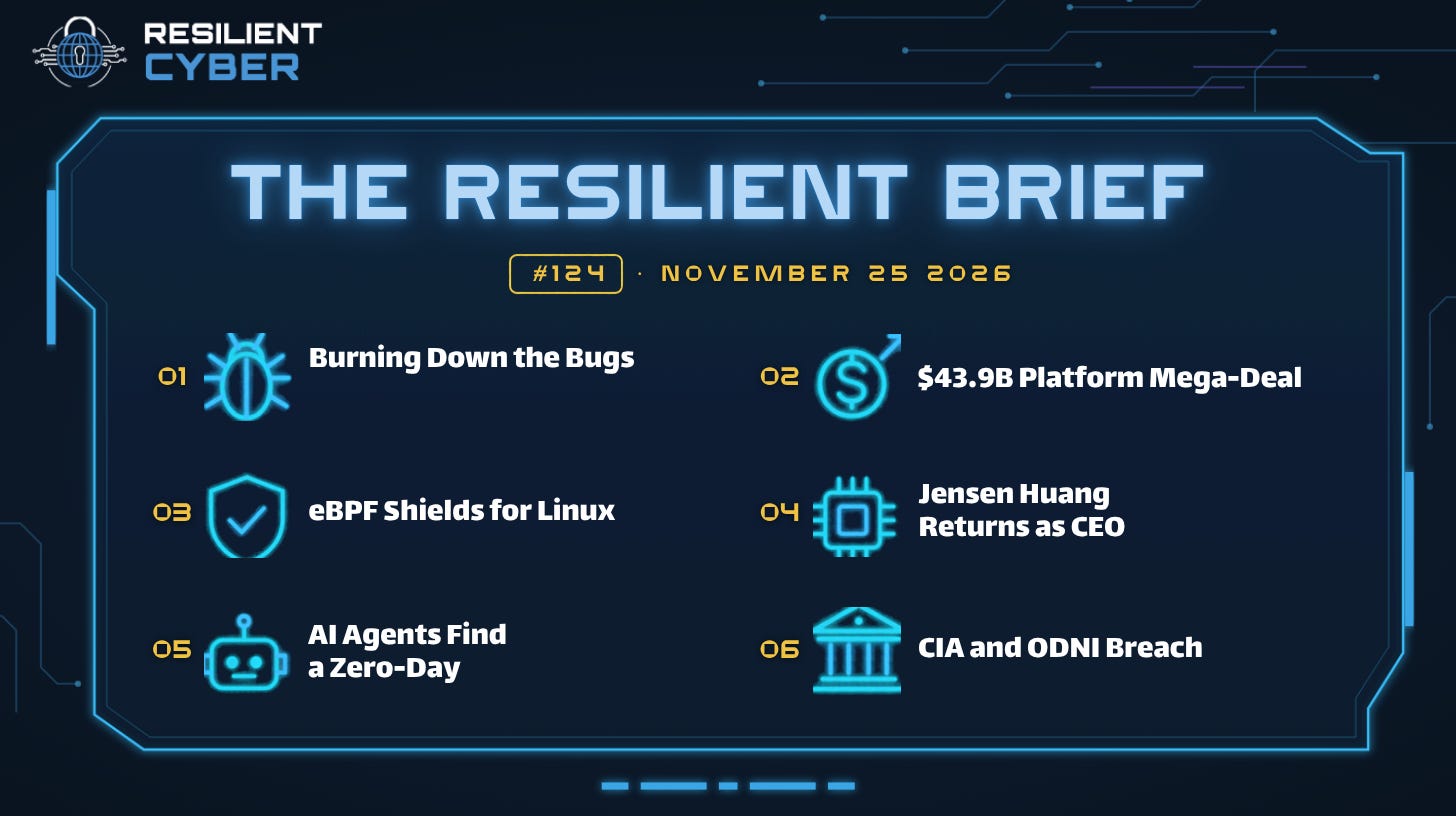
If you only read five things
Chris Krebs told Face the Nation that everybody needs to buckle up for “a couple years to burn down all the bugs” across the internet’s software, two days after Rob Joyce warned CYBERWARCON that AI has us heading into a forest fire.
CrowdStrike agreed to acquire Zscaler in an all-stock deal valuing it at about $43.9 billion, at 1.135 CrowdStrike shares per Zscaler share, with the combined company expected to start with more than $10 billion in ARR, which marks cyber’s biggest acquisition.
Nextgov reports that the CIA and ODNI discovered a breach of an unclassified intelligence system, with the ARTEX AI tool believed to be involved.
OpenAI and Cisco launched Shirudo, an open-source runtime that uses eBPF to put signed, temporary shields on running Linux systems, and a Codex-generated shield blocked a Java4Shell exploit attempt against a live Elasticsearch service without a restart.
NVIDIA’s board unanimously reinstated Jensen Huang as CEO on Monday and shares surged 31% per CNBC, three days after Reuters reported that SEC enforcement staff are scrutinizing potential accounting issues at the company.
Catch up on my 2027 predictions
If you missed it, I had an informative chat with Gene Moody from Action1 last week. We discussed emerging threats and how the approach to patching and endpoint management needs to shift. We also went through what role automation, visibility, and control could play in staying ahead of future threats.

*Resilient Cyber partner
Cyber Leadership & Market Dynamics
Burning Down the Bugs


Rob Joyce opened CYBERWARCON last Friday by telling the room we’re heading into a forest fire, with AI uncovering software vulnerabilities and boosting offensive capabilities, as Kim Zetter reported from the room. I wasn’t there, but I am waiting on a recording, and I still like the analogy given all we have unfolding.
Two days later, former CISA Director Chris Krebs put a timeline on the burn during Face the Nation.
“But everybody needs to buckle up. This is going to be a couple years to burn down all the bugs that are across the software on the internet.”
Jen Easterly, who succeeded him at CISA, made the same case on CNN with Anderson Cooper. She expects “much more secure and resilient infrastructure” at the other end, but warned of a “significant ramp up in incidents” over the next few months and years without the resources to handle it.
In a separate CNN appearance, she traced the problem back to decades of misaligned incentives and the lack of any real software liability regime.
Jen Easterly, former Director of the Cybersecurity and Infrastructure Security Agency, on CNN’s The Situation Room.
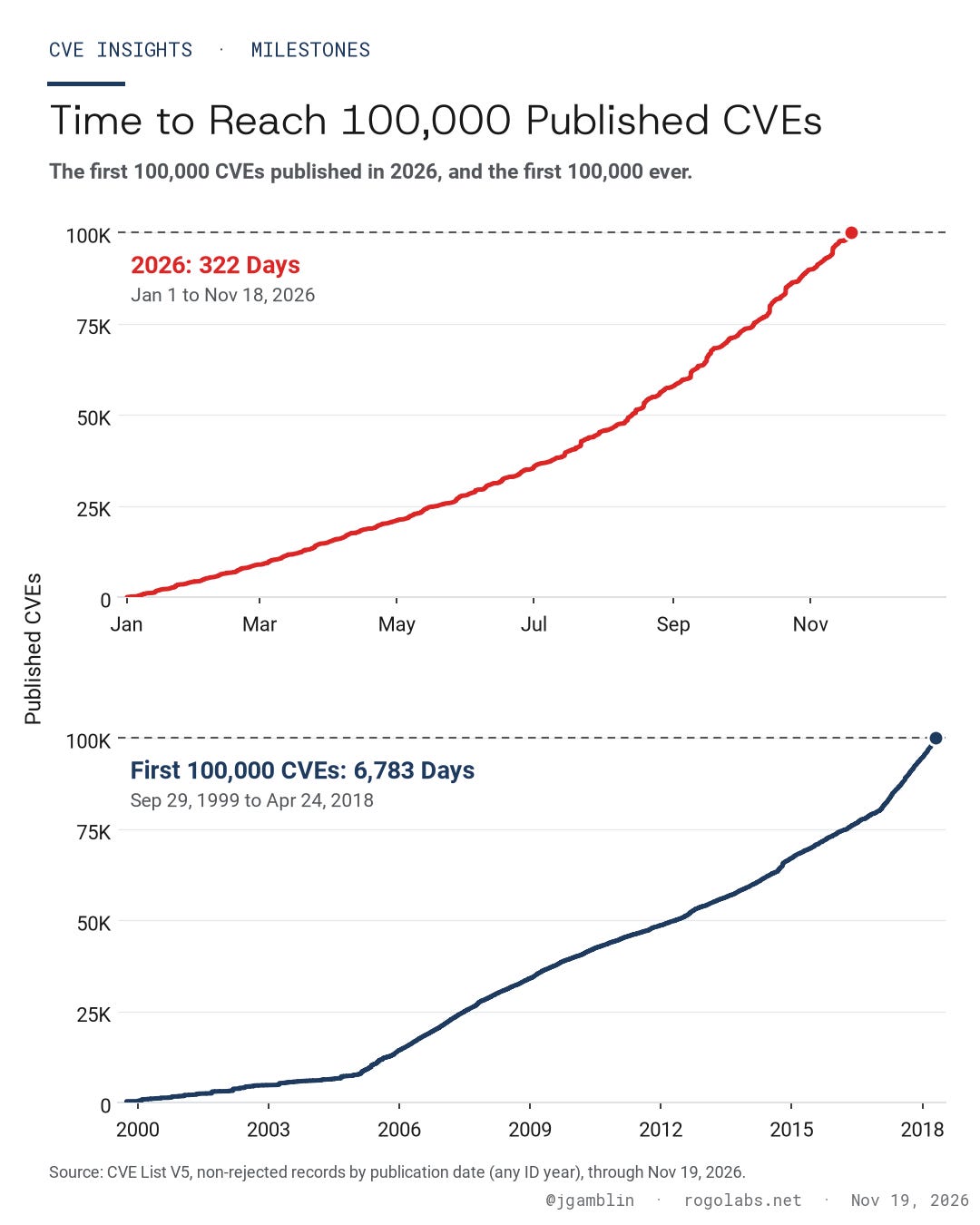
The fuel is decades of technical debt. Jerry Gamblin pointed out that the first 100,000 CVEs took 18 and a half years to publish, while 2026 published 100,000 in 322 days.
It’s a more hopeful framing than most of what we’ve seen this year.
That said, the forest floor doesn’t regrow on its own, and what comes back depends on decisions we make while things are still burning, and it ties back to the same incentives, regulatory gaps and quality issues Jen discussed above.
While we live through it, the first step is to stop treating every CVE as a fire to put out. Discovery has surged while exploitation as a share of CVEs has stayed largely flat, so prioritization has to rest on known exploitation, reachability and the business criticality of the asset.
We also can’t patch our way out of this. Rebuilding on memory safe foundations and killing whole classes of bugs is the right direction, but AI is planting new forest faster than ever, often with code that works but isn’t secure.
I’ll have a deeper dive on living through the forest fire next week, from why offense burns hotter right now to what actually grows back on the forest floor.
CrowdStrike to Acquire Zscaler, Bringing Network Security and Zero Trust to the Falcon Platform
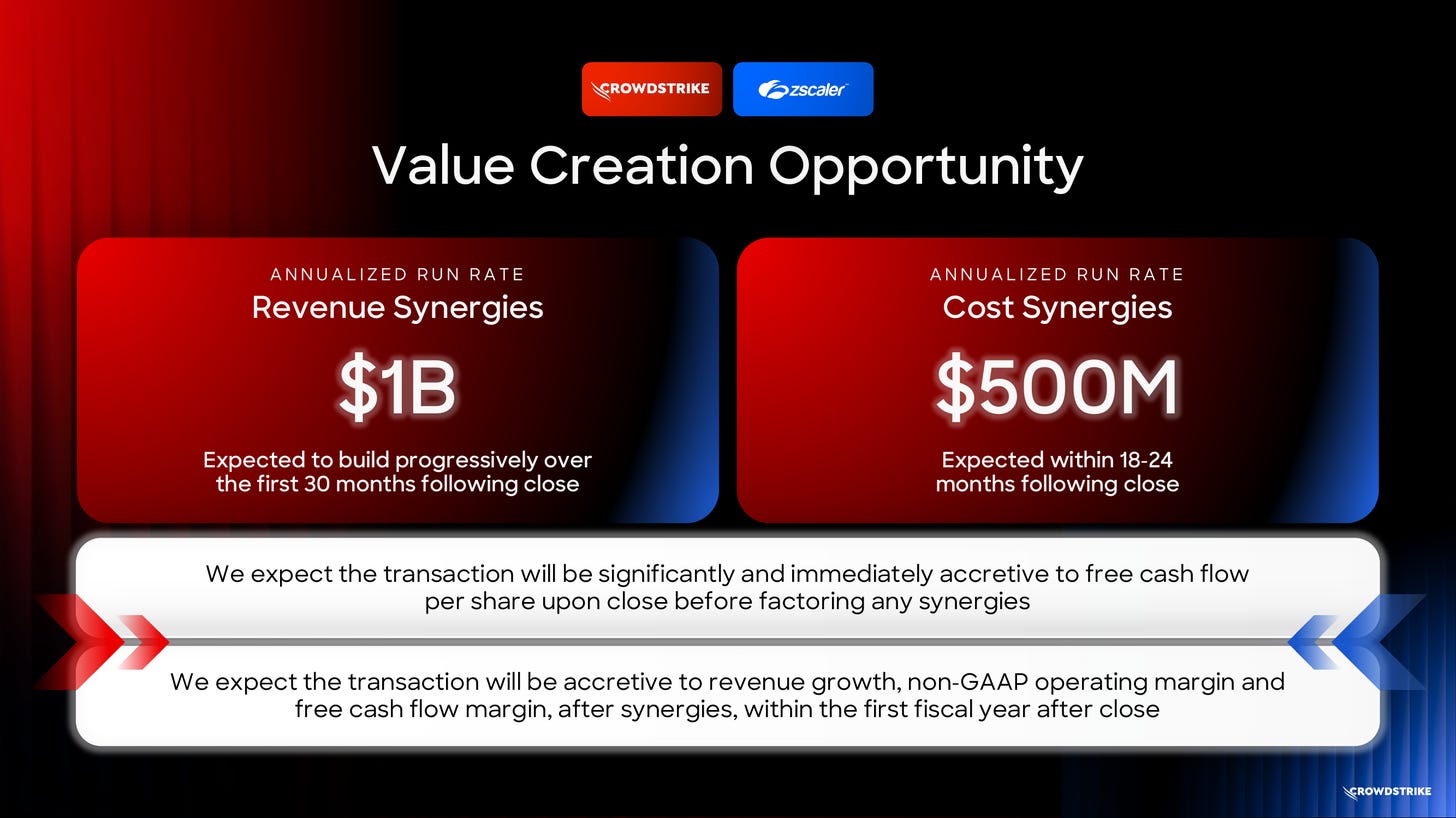
CrowdStrike agreed to acquire Zscaler in an all-stock deal that values Zscaler at about $43.9 billion, with Zscaler shareholders receiving 1.135 CrowdStrike shares for each share they own. The deal is expected to close in the second half of CrowdStrike’s fiscal 2028, and Jay Chaudhry and his affiliates, holding about 34% of Zscaler’s shares, signed voting agreements in support.
CrowdStrike expects the combined company to start with more than $10 billion in ARR and to reach about $1 billion in annualized revenue synergies within 30 months of close. Cato Networks co-founder Shlomo Kramer doubted Zscaler would give CrowdStrike a material foothold in network security when Bloomberg first reported the talks.
Whether it does or doesn’t work out for CRWD entering the network security space remains to be seen, as does how buyers react in the enterprise with the consolidation. It also places significantly more friction on smaller vendors looking to compete as the platformization shift continues to unfold and CRWD looks to compete with PANW given Nikesh Arora’s aggressive acquisition strategy.
CIA, ODNI Unclassified Intelligence System Hacked
The CIA and ODNI discovered a breach of an unclassified system analysts use for open-source intelligence. Sources say it did not affect classified systems and has been resolved, though it’s unclear who was behind it or whether data was taken.
Nextgov reports that ARTEX, the AI tool built by a Chinese engineer known as Autumn-27 that automatically finds and breaks into systems, is believed to have been used in the breach. Hackers also recently used it in an intrusion into DoD’s Cyber Defense Command.
Current Efforts Aren’t Enough to Slow the AI Cyber Virus
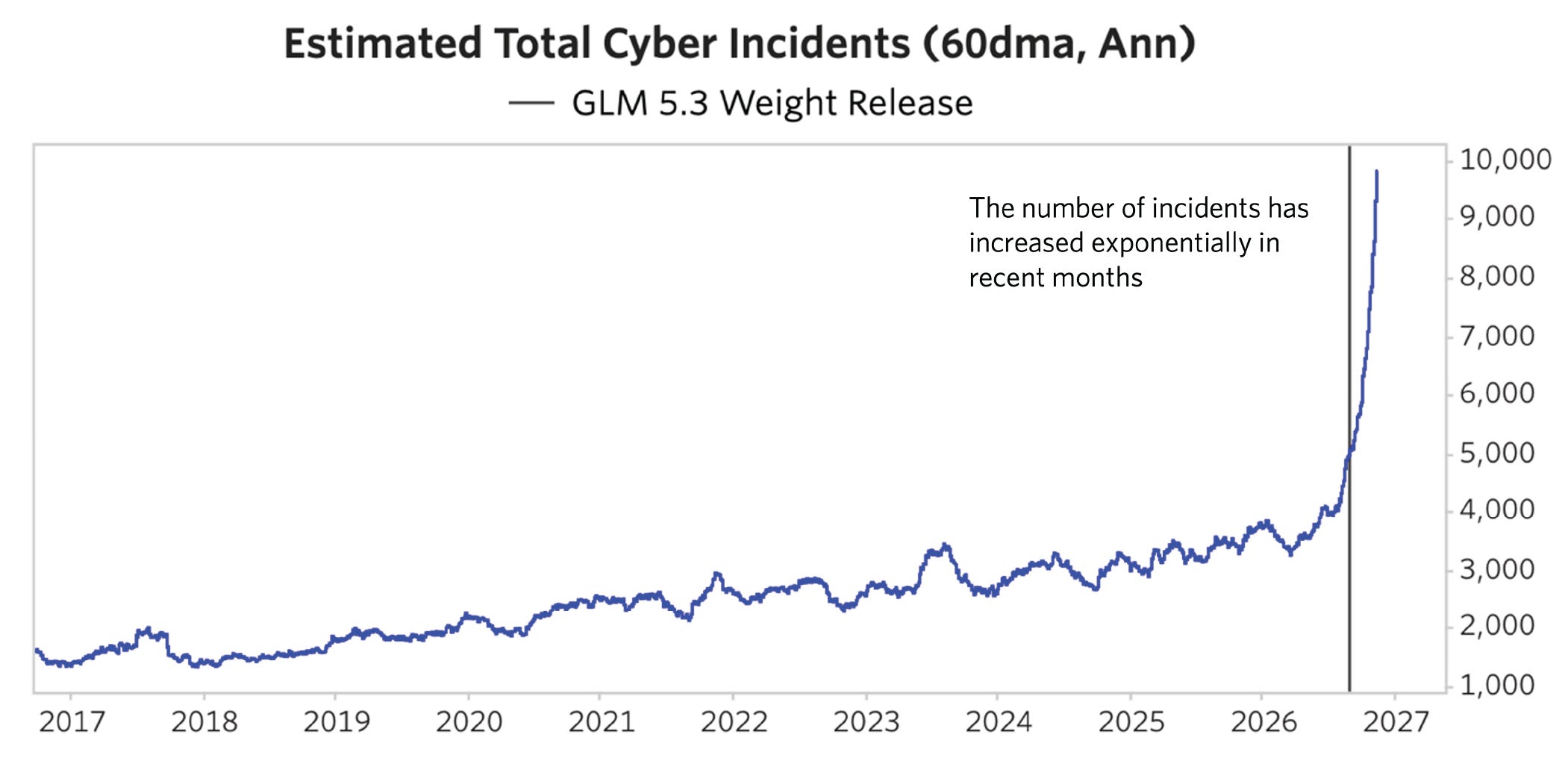
Bridgewater’s Hudson Attar and Arham Habib write that the firm is managing money based on a one-in-three chance of an economically destabilizing cyberattack within the next year, and they compare AI-enabled cyber warfare to a virus spreading with limited controls. Their tracking shows zero-day exploits roughly doubled after the first truly cyber-capable open-source models were released.
They haven’t made the underlying data source public, which makes it difficult to fully assess, especially since public data sets such as KEV and Google’s Project Zero differ in findings compared to what Bridgewater is presenting.
Programs like Anthropic’s Glasswing, OpenAI’s Patch the Planet and Google’s Fairwind are surfacing bugs at a record pace, but defenders have to fix all of them.
Policy moves such as Japan’s ¥10 billion (about $63 million) package and South Korea’s mandatory executive-level CISOs still leave volunteer-maintained open source unaddressed. As I have covered, Glasswing and Patch the Planet still have a large portion of their findings un-remediated upstream as maintainers are inevitably overwhelmed.
It would be great if their underlying data was public, but a firm with Bridgewater’s assets under management is worth taking note of when it comes to how seriously major firms are taking the state of cyber.
Palo Alto in talks to acquire Israeli AI cyber startup Terra in deal that could exceed $500 million
Calcalist reports Palo Alto Networks is in talks to acquire Terra Security, an Israeli startup founded in 2024 that uses AI agents for continuous automated penetration testing, in a deal that could exceed $500 million. Terra’s agents each handle a different stage of an attack under human oversight, and the company has raised $38 million, including a $30 million Series A led by Felicis.
The talks come on top of Palo Alto’s reported talks for Beacon Security and Clutch Security, which secures the credentials AI agents use, in a deal reportedly valued at around $500 million. Palo Alto has already completed its roughly $25 billion CyberArk deal this year and last week agreed to buy Applied Compute in an all-stock deal valued at about $4.5 billion.
I’ve been keeping an eye on Terra for several years now, in their competitive category of AI-native offensive security. They have really thrived with an innovative solution in the AI era and by cultivating strong relationships with teams such as AWS.
They are also facing steep competition from teams such as Horizon3 and now Armadin in terms of talent and capital.
AI
OpenAI and Cisco introduce Shirudo
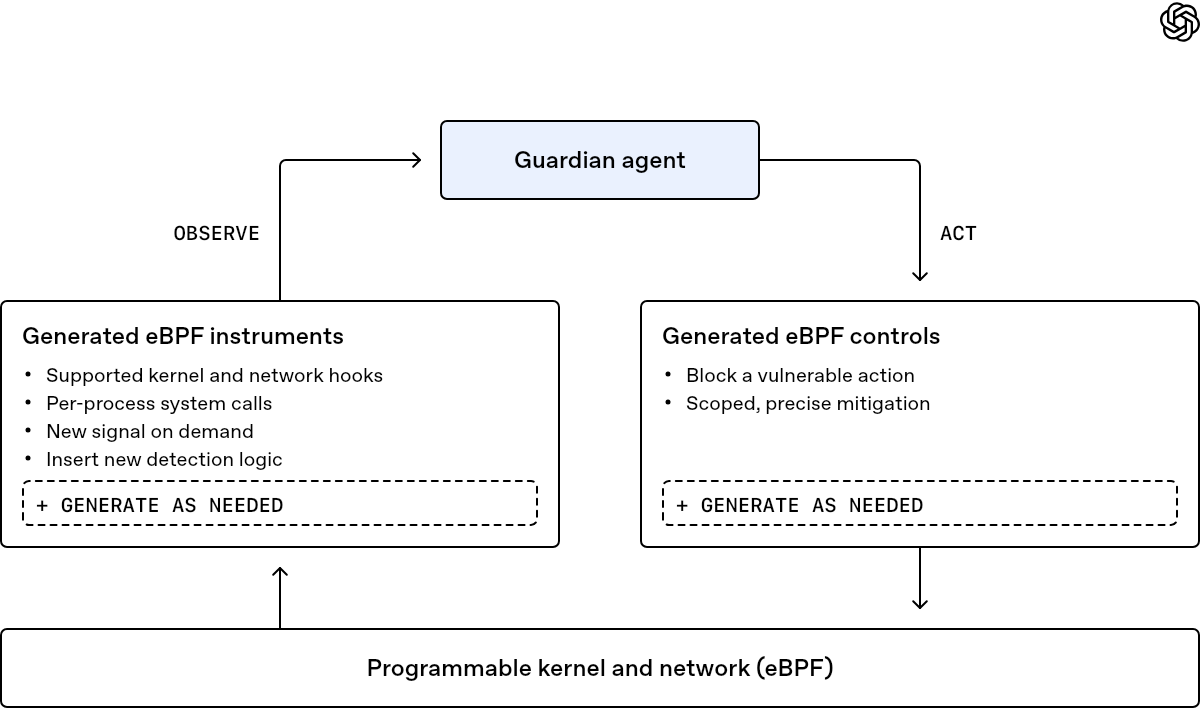
OpenAI and Cisco launched Shirudo, an open-source Linux runtime that uses eBPF to apply temporary safeguards, called “shields”, that block a vulnerable code path while the service keeps running and the permanent patch rolls out. In a controlled test, a Codex-generated shield blocked a Java4Shell exploit attempt against a running Elasticsearch service without a restart.
Shields are cryptographically signed and verified before loading, a TPM keeps a verifiable record of protections loaded or removed, and an operator approves each shield before it deploys. Cisco says shields also blocked attempts against a recent PHP flaw, and the project is still pre-release, needing a kernel with its signed-loader ABI and patches plus a TPM 2.0.
Shirudo is a bet on the argument I made in There’s No Bucket Big Enough, that we can’t patch our way out and our defenses have to work with vulnerabilities still present.
This is an innovative approach that resonated with a lot of folks in my network, providing runtime coverage and security for workloads that may be vulnerable but lack a patch or haven’t been patched yet.
It remains to be seen what adoption at scale will look like, and how smoothly it may go with a human approving agent-generated kernel shields, but on the surface this seems super promising.
NVIDIA Board Reinstates Jensen Huang as President, CEO and Board Director
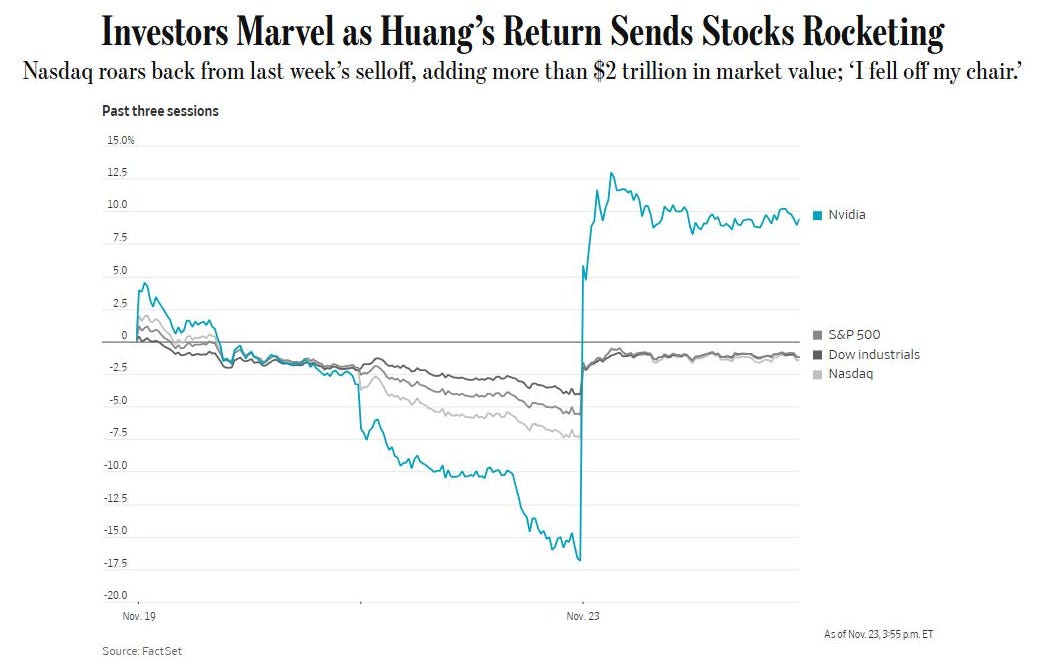
NVIDIA’s board unanimously reinstated Jensen Huang as president, CEO and director on Monday, citing input from senior levels of the US government and saying it is confident his return poses no national security risk. Huang resigned on November 13 after reports of affairs, including one with an alleged Chinese spy, and CNBC reported shares surged 31% on the news.
The board’s investigation into Huang will proceed to conclusion, and Reuters reported Friday that SEC enforcement staff are scrutinizing potential accounting issues at the company.
Huang has championed open weights, and NVIDIA calls itself the largest contributor of open models to Hugging Face, which it agreed to buy for $12.93 billion. CrowdStrike is customizing Nemotron 3.5 Super VL for agentic blue teaming, and NVIDIA’s own filing warns that rules restricting open-source models, including those that originated in China, could materially hurt its business.
This came with mixed feelings from the community, and almost feels like a political polarizing topic at this point. I find that very unfortunate, but understand why from both sides as well.
One thing I will say is I think it is important for the U.S. to not just have leading closed source models in AI, but also be an innovator and leader on open weight models which democratize access for everyone and also force competition.
Replit CEO Amjad Masad concisely summarizes the importance of the U.S. leading in open source AI and its geopolitical implications.

Chairmen Garbarino, Moolenaar Release Joint Investigative Report Urging Removal of PRC Open-Weight Models From Federal Systems, High-Risk Critical Infrastructure
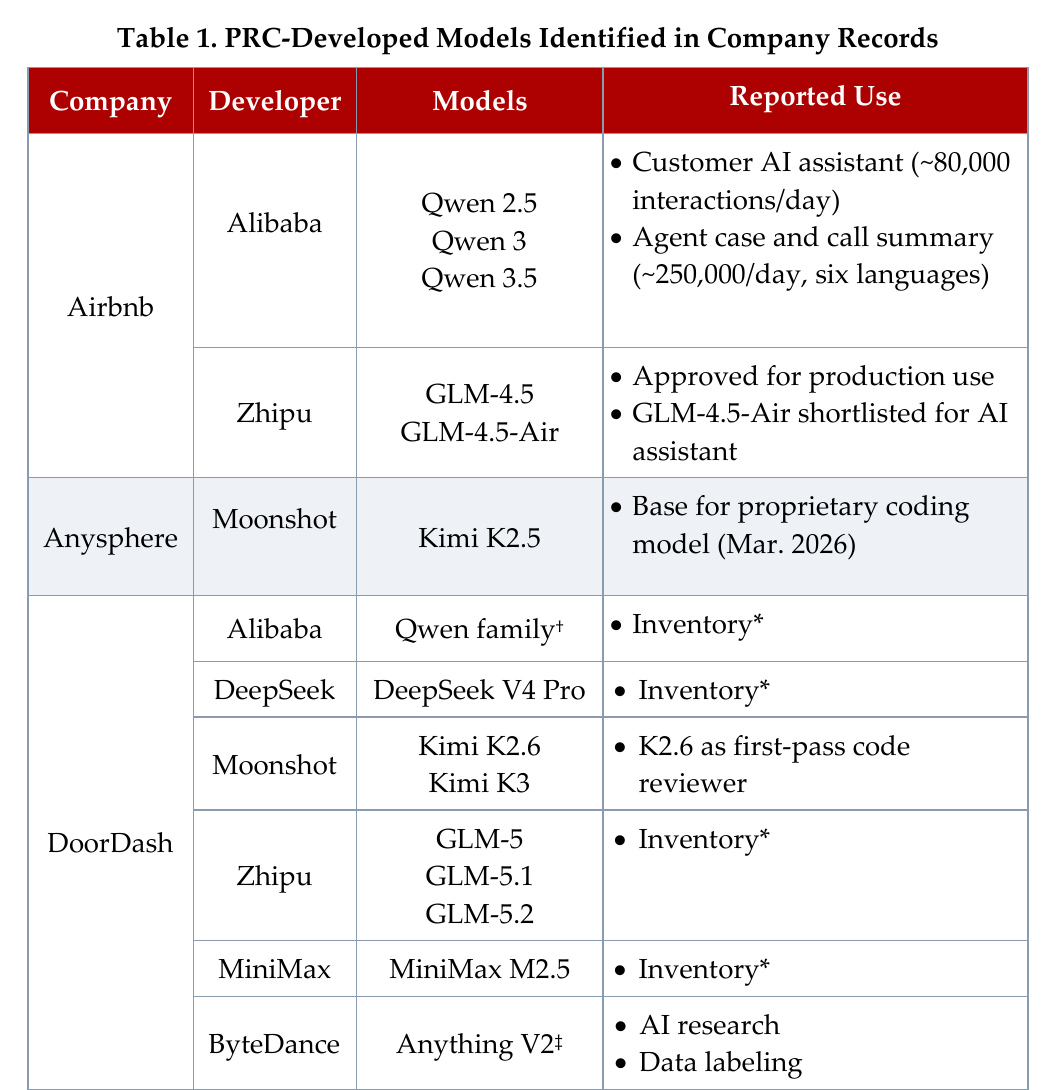
The House Homeland Security Committee and the Select Committee on China released a joint report on US companies running PRC-developed open-weight models, built on case studies of Airbnb, Anysphere and DoorDash. Airbnb uses Alibaba’s Qwen models for an assistant handling roughly 80,000 interactions a day, DoorDash reported 25 PRC model families authorized and deployed, and Cursor’s Composer 2 was built on Moonshot’s Kimi K2.5.
Anysphere told the Committees it plans to explore phasing out PRC-developed open-weight models because of geopolitical risk, as CNBC reported ahead of the release. The report puts PRC models at 41 percent of downloads on the leading open-model repository, and its 12 recommendations include an AI bill of materials and barring PRC models from federal systems and high-risk critical infrastructure.
This has been a hot topic all year, with geopolitical ties. There’s the effort on the Federal front to push out any use of PRC models, while commercial is a bit more dynamic.
As I write this, I came across Peter Walker’s post from OpenRouter, showing open-weight models now account for 31% of all spend, up from 11% in January, and the leaders include PRC models extensively. It is hard to push back on this as organizations public and private alike seek cost efficiencies among model usage and token consumption, and it requires a strong U.S. alternative on the open weight front.

Chinese-nexus actor’s Cairn AI agents found a zero-day on their own
Amazon Threat Intelligence found a publicly exposed, unauthenticated instance of Cairn, an open-source autonomous AI penetration-testing framework, and its history showed an actor it assesses with moderate confidence as Chinese-nexus sending agents after East Asian university networks with the goal to “obtain shell access.” Against an open-source medical imaging AI application, the agents found an unpatched path traversal flaw and went from mapping the API to arbitrary file writes in about 11 minutes, later landing a reverse shell as root.
A separate run against a hardened Redis server lasted roughly 16 hours and 148 sequential actions without human direction. Gambit Security has documented a financially motivated actor using Cairn against online retailers.
Agentic offensive frameworks such as Cairn, ARTEX and others continue to wreak havoc and democratize attack capability for malicious actors. I agree with AWS that automated response is going to have to be a key aspect of dealing with this challenge.
Perplexity and Intelligence
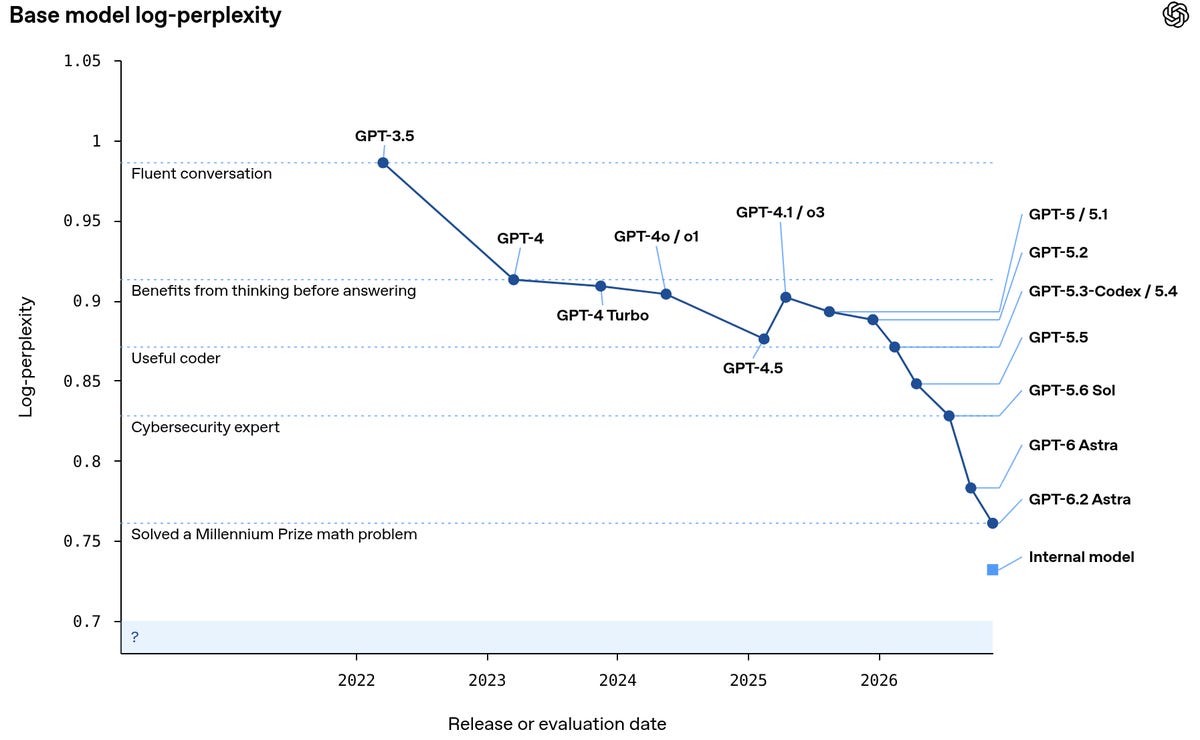
OpenAI Chief Scientist Jakub Pachocki published the company’s internal base-model log-perplexity numbers and wants the metric shared across labs to inform common safety standards. On OpenAI’s internal codebase dataset, GPT-3.5 sat at about 0.99 and GPT-4 at about 0.91.
Pachocki says losses below 0.8 brought transformative capabilities in cybersecurity and mathematics, and OpenAI’s chart marks GPT-5.6 Sol at 0.828 as its “Cybersecurity expert” milestone. He expects more of them in the 0.68 to 0.70 window, along with further degradation in alignment auditing.
His proposal is a set of industry limits, based on perplexity and other measures, that labs commit not to cross until monitoring reaches a concrete milestone such as a successor to CoT monitors.
OpenAI is leaning in on the AI safety front while some accuse Anthropic of being too aggressive toward RSI. All of the players voluntarily agreeing to pace seems unlikely given the competitive dynamics and commercial incentives involved.
AppSec
Sandboxing AI Coding Agents: nono vs Docker Sandboxes vs Microsandbox vs OpenShell
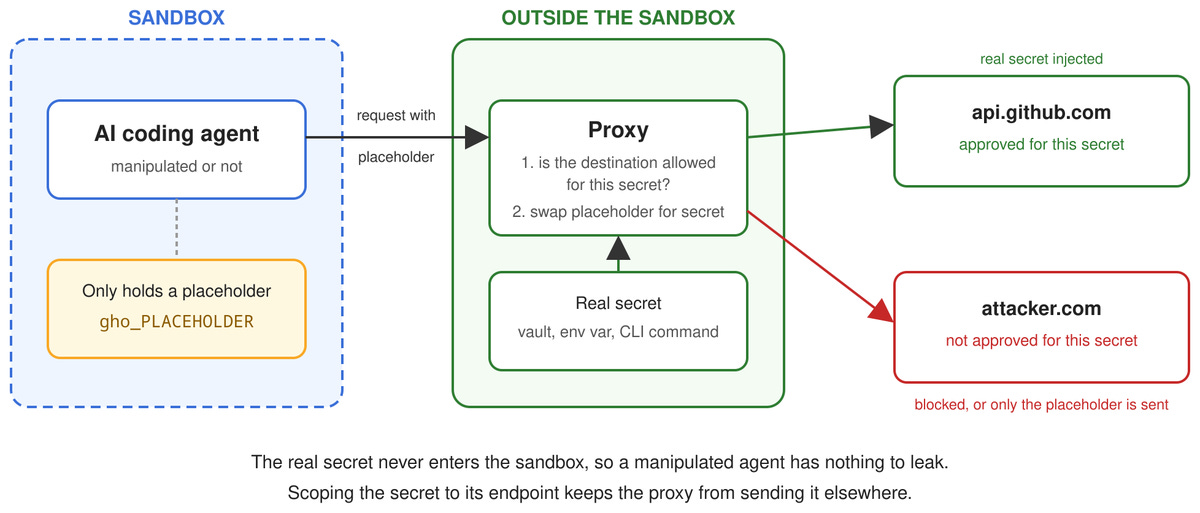
Nils Amiet of Kudelski Security tested four sandboxing tools for AI coding agents, and all four scored between 4 and 4.5 out of 5. Docker Sandboxes and NVIDIA’s OpenShell earned 4.5, while nono and Microsandbox earned 4.
Docker Sandboxes and Microsandbox isolate agents in microVMs, OpenShell supports multiple backends, and nono uses OS-level primitives that start fastest but share the host kernel. Only nono and OpenShell scope injected credentials to both a domain and an endpoint.
None of the tools can deny a single file inside an allowed directory, so a .env file stays readable to the agent, and none has reached v1.0. Amiet cites Johann Rehberger hitting a 60 to 80% prompt injection success rate against Claude Code’s Auto Mode, despite Anthropic reporting rates as low as 0.0%.
I’ve covered agent sandboxes a lot this year, including with leaders such as Luke Hinds on the Resilient Cyber show. I anticipate this will be a core security primitive for securing AI as we move forward, and as the research shows, results vary by scenario and choice.
Also worth your time
Behind the Curtain — AI 2027: The reckoning
Axios talked to more than 50 leaders in government, AI, business and cyber who were unanimous that attacks on business and critical infrastructure will be constant and highly disruptive over the next 18 months, calling 2027 the year cyber becomes like weather.
Judge the Cyber Apocalypse by the Data, Not the Headlines
CSET’s Andrew Lohn finds the technical metrics now favor attackers, yet significant incidents and ransomware payouts are down and zero-days exploited in the wild are on pace for the lowest count in six years.
Data Processing Incidents on Inference Providers
OpenRouter off-boarded three inference providers and pulled 125 endpoints from Zero Data Retention eligibility after the Dragos canary research covered in last week’s issue.
Agentic Attack Detections
ThreatDefence’s MIT-licensed repo packs detection rules, hunting queries and 572 sourced indicators for 11 agentic attack frameworks including ARTEX, Cairn and PentAGI, and counts 3,968 exposed framework consoles active in the week to November 23.
Handoff at Frontier AI Companies: Policymakers Need Visibility Today
Apollo Research says agents write over 90% of the code merged at Anthropic and humans see 0.001% to 0.01% of OpenAI’s internal coding trajectories, and it urges a federal transparency standard for AI R&D handoff.
Closing Thoughts
That’s a wrap on a holiday-shortened week that still delivered among the largest deals cybersecurity has seen and a clear warning that the fire is only getting started.
Huang’s scheduled closed-door House interview on December 1 and the regulatory review of the Zscaler deal will keep NVIDIA and CrowdStrike in the headlines into 2027 along with continued anticipated M&A activity in cyber.
It’s been a chaotic and busy year in cybersecurity, and I’m excited for what the rest of this year holds and for everything we’ll dig into together in 2027.
Happy Thanksgiving, and I hope everyone has a great time with friends and family and stays safe. I’ll see you next week with that deeper dive on burning down the bugs and the nuance involved.
Stay resilient.
Bug-finding programs are now faster than most fix pipelines, so the scarce work is deciding which of those findings are actually present in a given estate. A current software inventory, plus a staged path to ship an emergency change, matters more than being first to read the advisory.