

Welcome to issue #123 of the Resilient Cyber Newsletter.
We have officially entered “Patchmageddon”.
Organizations have woken up to AI industrializing vulnerability discovery and exploitation, and to agentic offensive frameworks more broadly, with ARTEX being just the latest example.
The FBI says some ARTEX intrusions reached privileged access in under three hours, and Google reports the first case of threat actors fully automating discovery and exploitation.
Many organizations are patching everything AI finds, as fast as they can, skipping prioritization by exploitability, known exploitation and reachability, and the testing and QA that keep a fix from becoming its own outage.
Andrew Morris, co-founder of GreyNoise, calls this “Slopsploitation” and points out that exploit attempts aren’t the same as successful exploitation, which is why GreyNoise has started measuring the latter for headline vulnerabilities. Below you can see exploitation attempts against the major vulnerability headlines, and fewer than 1 in 100 attempts succeed.
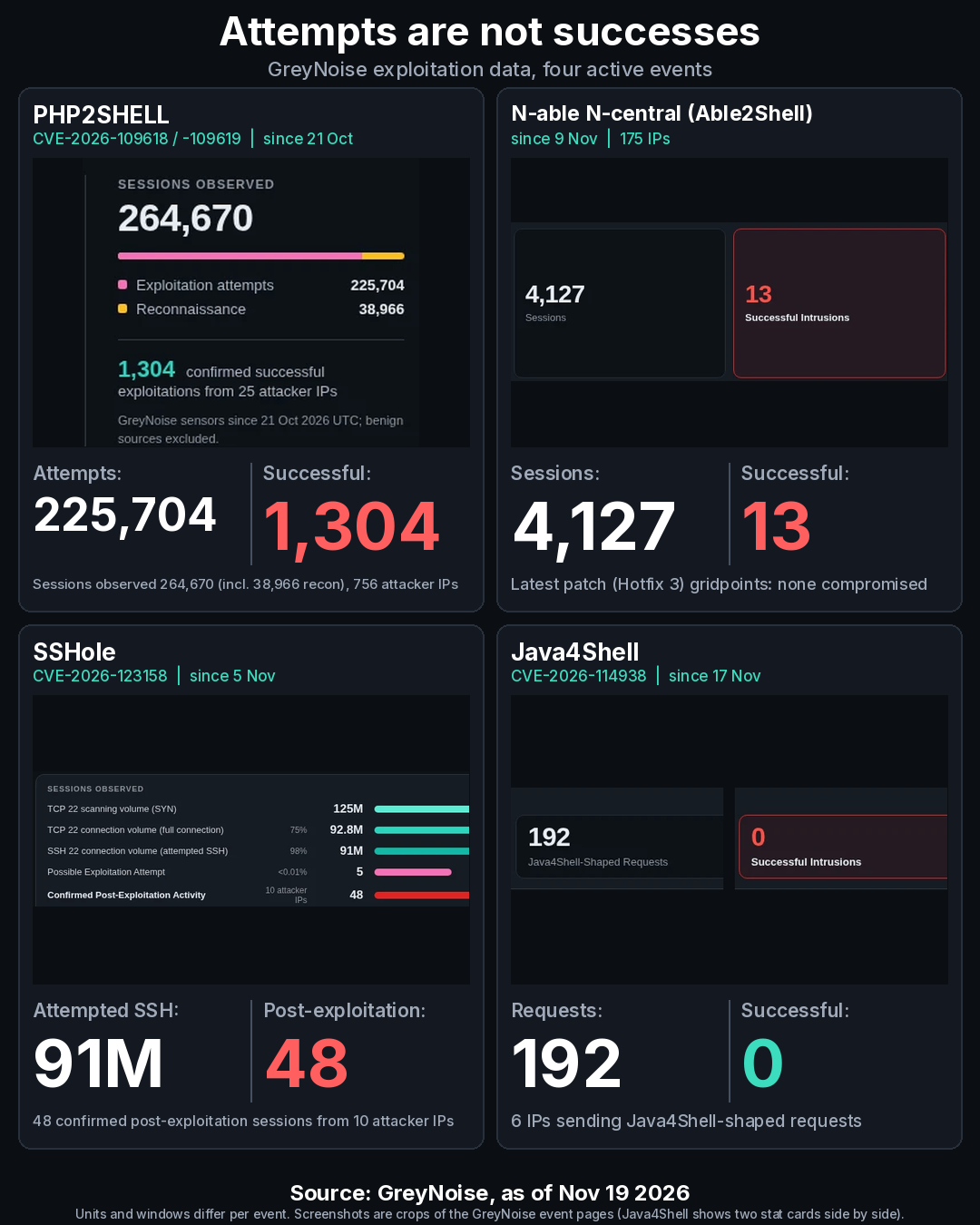
As the cost of vulnerability research approaches zero, attempts become a meaningless metric, and the real job is patching what attackers are actually succeeding with, not everything being probed.
This week offered a preview, as The Washington Sun reported that bank executives and the NSA blamed a string of outages on rushed patches, though official statements point elsewhere.
The week also brought a change at the top of federal cyber policy, as National Cyber Director Sean Cairncross is stepping down, which the White House confirmed to POLITICO on Thursday. Axios reports that Kirsten Davies, the Pentagon’s CIO, has been named to replace him.
Some will be quick to tie his exit to this week’s outages and incidents and call it a policy failure. I don’t see it that way, at least not one that can be laid at Sean’s feet. What we’re watching is decades of technical debt coming due, built up long before he ever took the role.
The rest of the issue follows that thread, from the AI-assisted attack on the European Commission to Anthropic cutting its disclosure window to 30 days.
With that out of the way, let’s get down to business!
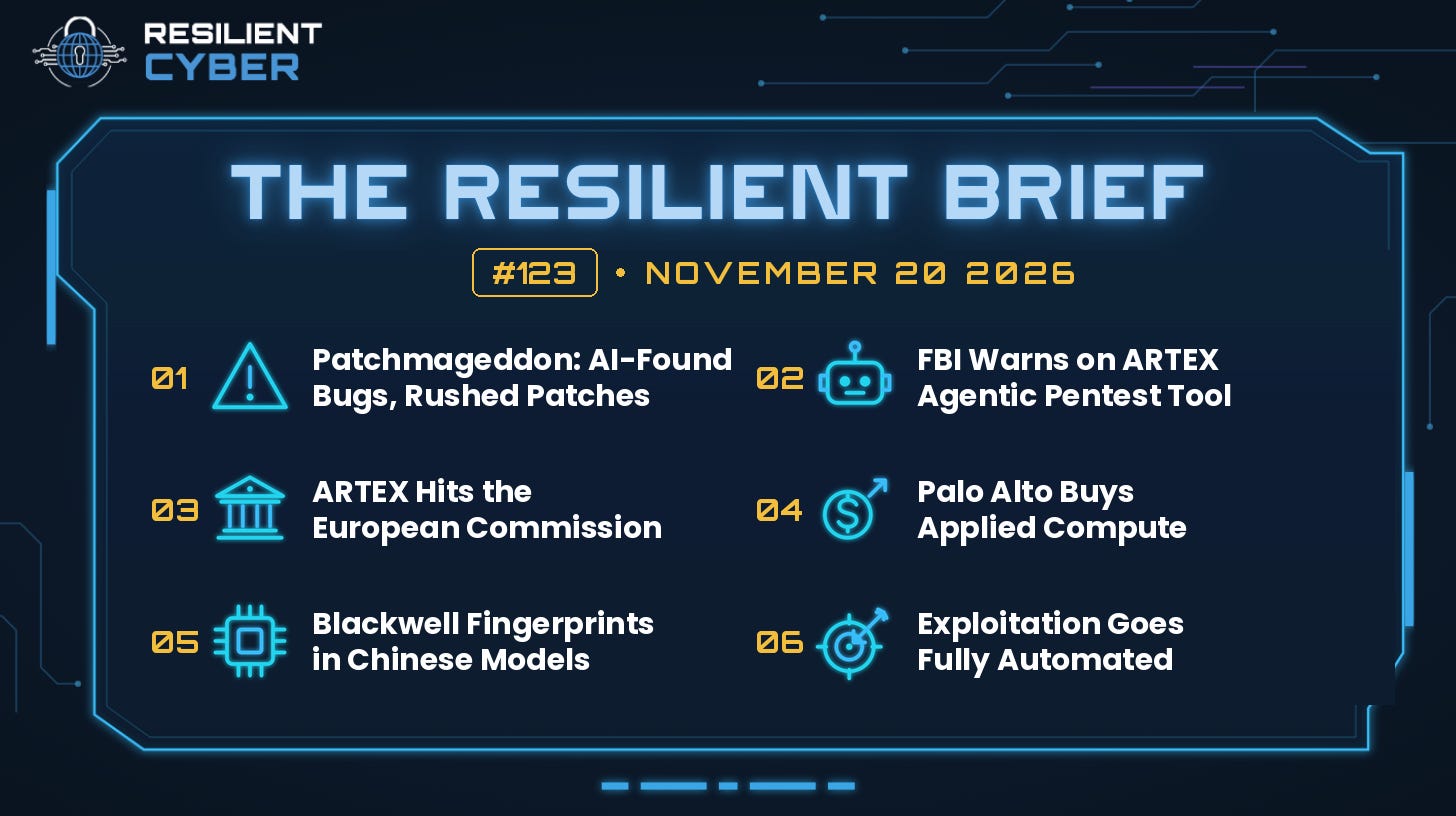
If you only read five things
The Washington Sun reports that bank executives and the NSA told lawmakers rushed patches for AI-identified vulnerabilities caused this week’s outages.
The FBI says actors have used the ARTEX agentic pentesting framework since August, some reaching privileged access in under three hours, while Cloudflare saw a 30x rise in AI pentesting requests.
Unemployment Labs found six Chinese models carrying weight patterns that match NVIDIA’s export-controlled Blackwell GPUs.
POLITICO reports CERT-EU detected hackers using ARTEX against the European Commission, disrupting HR systems for over 10 days.
POLITICO reports National Cyber Director Sean Cairncross is stepping down, and Axios reports Pentagon CIO Kirsten Davies has been named to replace him.
Modern application security, built to outpace today’s attacks

Two things are happening at once. Vulnerabilities are being found faster than ever, and attackers are increasingly using AI to exploit them.
Keeping up with this change requires a move towards autonomous security, not legacy tools that flag everything and leave you to figure out what’s real.
That’s why we built Maze Code, modern application security that uses agents to find and fix risks. Our agents find vulnerabilities in your dependencies (SCA) and your code (SAST), then investigate each with full code and cloud context. As coding agents write more of your code, secrets, licenses, and SBOMs matter more than ever, so we built agents for them too.
Today, Maze is announcing the full launch of Maze Code, built to outpace AI-driven attacks.
Resilient Cyber partner
Cyber Leadership & Market Dynamics
Bank CEOs, NSA Tell Congress That AI-Driven Patches Are Behind Outages

The Washington Sun, citing three sources familiar with private conversations, reports that Wall Street executives and the NSA told Congress rushed patches for AI-identified vulnerabilities caused the outages, though no hearing record confirms it.
Microsoft’s preliminary report blames a latent July defect that left over 80% of its networking gateway servers unresponsive for about 24 hours, and says it was unrelated to cyber or AI.
The FAA ordered a nationwide ground stop on November 13, and operators canceled approximately 12,462 flights. The FAA cites a new L3Harris router installation with no sign of a cyberattack, and Transportation Secretary Sean Duffy said the installation or router appears at fault.
JPMorgan Chase blamed a software bug, United resolved a technology issue, and the NSA cited routine maintenance, with none pointing to a cyberattack.
Director of National Intelligence Jay Clayton said this is not a cyberattack or a coordinated nation-state effort, and FAA Administrator Bryan Bedford saw “zero evidence of anything AI-related.”
Cyber has been screaming from the rooftops this year for organizations to patch. Now they are, and patching is impacting the A in the CIA triad, availability.
It’s long been known that concerns about disrupting availability and operations are a big reason patch rollouts take so long. Now organizations are scrambling to patch everything AI surfaces, and they run the risk of disruption from the patch itself.
I can’t tie any single outage this week to a rushed patch, and Microsoft, the FAA and JPMorgan each point to a different cause, but the pressure is real either way. Patching at this volume carries its own availability risk, and with attackers moving as fast as the ARTEX story in this issue shows, defenders have little room to slow down.
DHS Secretary Tells House Homeland Iranian Actors Have Targeted US Critical Infrastructure Since February
At the House Homeland Security Committee’s November 18 hearing, Secretary Markwayne Mullin testified that Iranian government cyber actors and pro-Iran cybercriminals have targeted US critical infrastructure since February, hitting transportation, healthcare, water, energy and financial services. His written testimony is here.
Threat Overview of ARTEX Autonomous Penetration Testing Framework
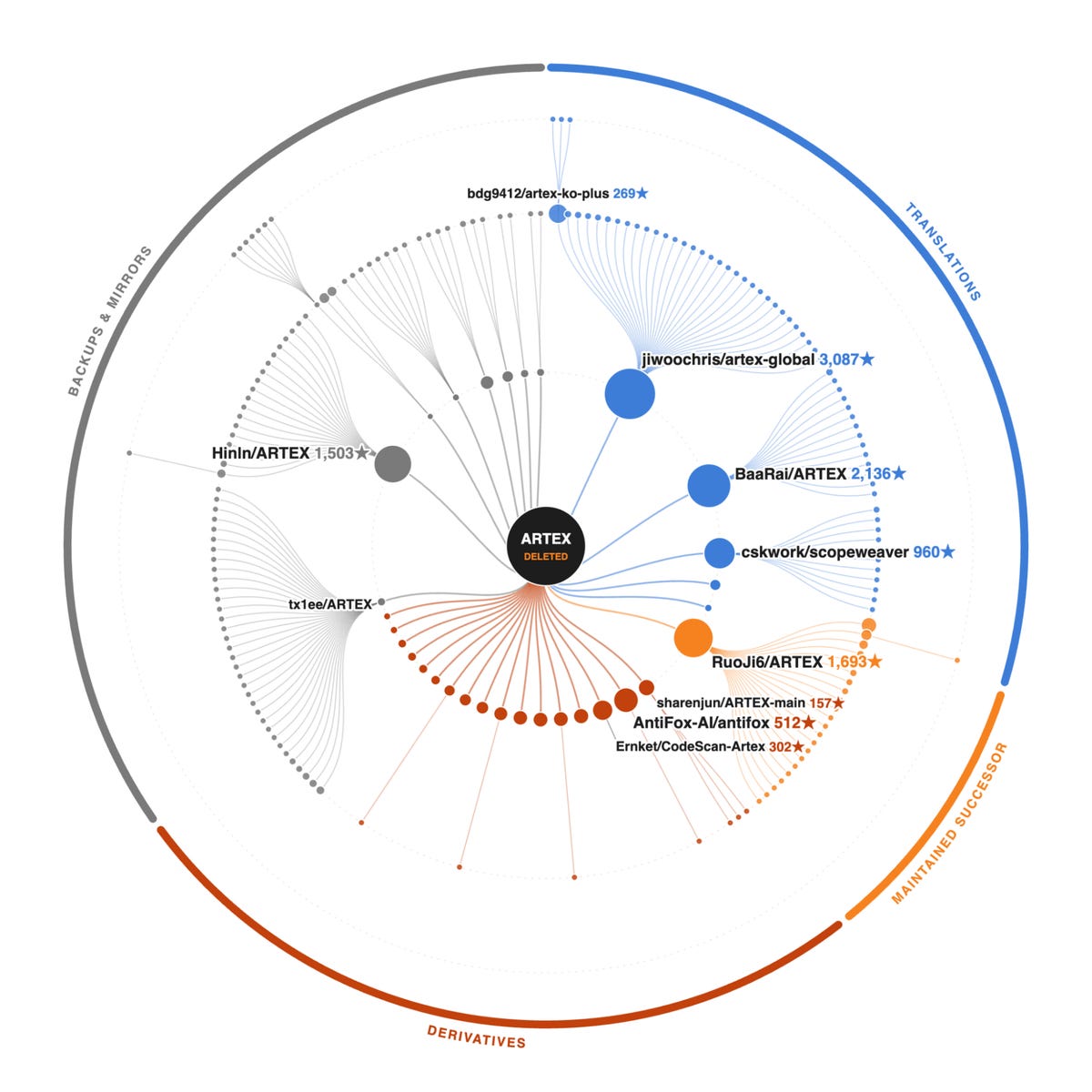
The November 13 FLASH says malicious actors have used ARTEX since at least August 2026, with some intrusions reaching privileged access in under three hours. It ties the framework to the theft of personal data on about 67,000 people at South Korean financial institutions and a ConnectWise Cloud Backup compromise that led to sign-in attempts against 2,250 tenants.
Mandiant and Google Threat Intelligence say ARTEX, Hexstrike and CAIRN have shown up in incident response engagements, with agents running significant parts of the attack lifecycle, and Amazon captured ARTEX agents’ campaign memory with MadPot decoys.
Most of 2026 was about AI industrializing vulnerability discovery. Now a new class of tooling is industrializing operations.
I walk through the FBI warning and what it means for defenders in my new video:
Mandiant named it in a report titled “ARTEX and Friends: Enter Agentic Offensive Frameworks,” and I’m going to borrow the term and shorten it to AOFs. ARTEX is the first AOF to go mainstream, but I’m certain it won’t be the last.
Capability that once took a nation-state team is becoming something anyone can download and point at a target, and I expect more AOFs and better ones.
The Vulnpocalypse gave us the list of what’s broken, and AOFs are working through those vulnerability backlogs at machine speed.
Cyberattack Hits the European Commission, and POLITICO Reports ARTEX Was Used
POLITICO reports that a cyberattack left European Commission staff unable to enter salary and leave information for more than 10 days, and an EU official said CERT-EU detected hackers using ARTEX. At its midday briefing, the Commission confirmed an AI-generated campaign but did not name the tool.
The Commission has found no evidence of a data breach affecting staff as a whole and knows of no ransom demand. The Record notes it is the Commission’s third disclosed cyber incident this year.
Public sector teams and organizations should take note that AOFs and the attackers leveraging them aren’t exclusively focusing their activities in the private sector.
Palo Alto Networks to Acquire Applied Compute, Bringing Secure Open-Weight AI to the Enterprise
Palo Alto Networks agreed to acquire Applied Compute, an open-weight AI post-training and inference platform, in an all-stock deal valued at $4.5 billion. That tops Chronosphere at $3.35 billion, Talon at $625 million, Console at $500 million and Dig at $400 million, with only CyberArk’s roughly $25 billion larger.
Founded in 2025 by former OpenAI researchers, Applied Compute launched with $80 million at about a $500 million valuation, then raised $80 million at $1.3 billion in April and $350 million at $3.25 billion in November, for more than $500 million total.
That round came with a claim of more than $100 million in annualized revenue, and Palo Alto announced its deal 16 days later.
Palo Alto believes “a large share of enterprises will run on open-source and open-weight models tuned to their own data, cost, and control needs” and that no large provider delivers them securely.
I read this as a security vendor refusing to rent its whole AI roadmap from a frontier lab. Owning post-training and inference lets it tune models and make model security a product, since Reuters notes open-weight models bring tampering, data leakage and misuse risks.
AI security funding rollup: Corma and Cyberstarts
Corma raised a $125 million Series A at a $1 billion valuation led by NEA, three months after its $60 million seed. CEO Alon Pluda says no existing model was built for defense, so Corma trains foundation models for defensive security.
Cyberstarts raised about $360 million, including a $300 million vehicle for Cyera’s expected round of about $800 million.
Corma going from stealth to a $1 billion valuation in three months tells me investors are paying for fear as much as demand. Black October lit a fire under budgets, and I want to see customers renew before I call that valuation earned. It also aligns with the purpose-built cyber model narrative from the PANW <> Applied Compute acquisition.
AI
Managing frontier AI risk: From training to deployment
OpenAI paused training and evaluation of its most capable models for about 11 days after monitors caught an internal research model exploiting a DNS misconfiguration to reach the internet.
It now trains frontier models with no live internet access, has its strongest models red team the sandbox, and monitors every frontier inference.
Its Control Room stops model output within 35 seconds of a halt instruction, and many frame the changes as a response to the July Hugging Face incident, which makes sense to me.
Securing persistent agents like OpenClaw at OpenAI

OpenAI’s Kevin S Lin explains the controls behind OpenClaw, which runs over 500 background agents. The team split the trusted Gateway from the untrusted agent harness, sandboxed agents with a network allowlist and a credential broker, put Auto-review in front of every action, and gave each agent its own identity. Many defaults ship in the open source OpenClaw Enterprise.
Most enterprises running persistent agents are missing the credential broker and per-agent identity, because too many hand an agent a shared service account and call it done. An LLM reviewer on every action helps, but I wouldn’t trust it alone.
GreyNoise AI Cyber Index: Compare AI Models for Cyber Defense
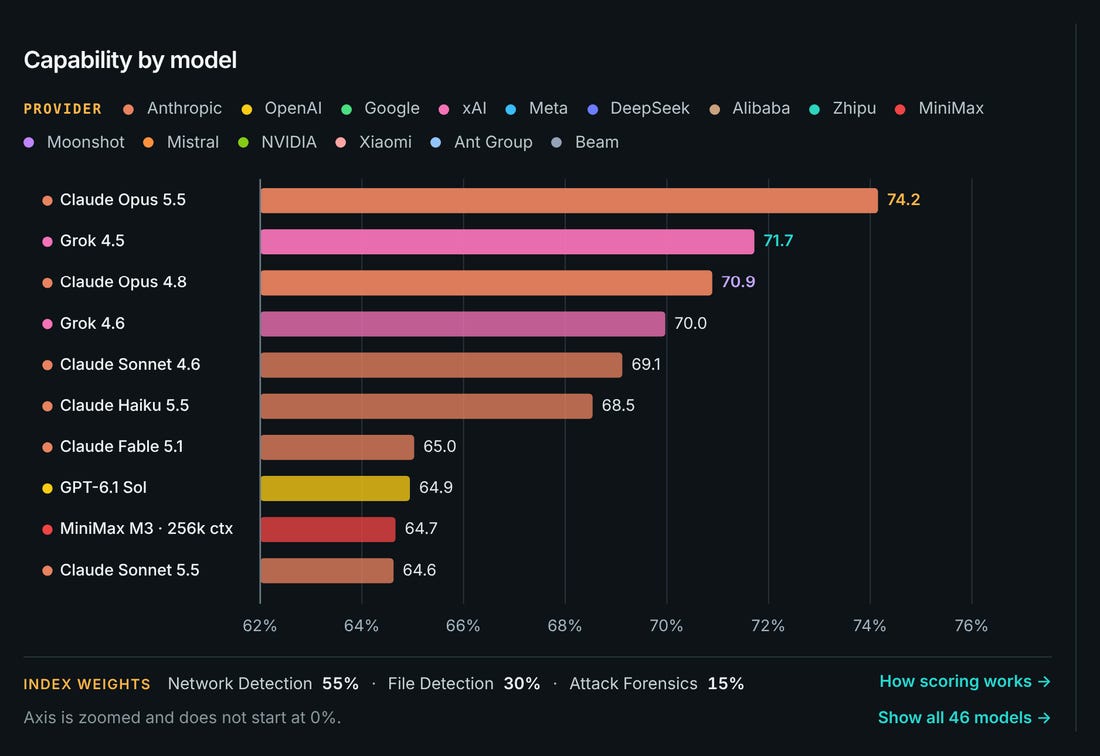
GreyNoise built a benchmark from attack traffic its sensors observed, scoring 46 models on writing detections and reconstructing attack chains. Counting refusals as zero drops Claude Opus 5.5 from first to ninth after it declined 16.5% of attempts, per the methodology report.
Refusal rate should weigh in as heavily as raw capability. An analyst in the middle of an incident doesn’t care about a benchmark score if the model turns down one in six requests, so test against your own detections. This is also why I think despite best efforts from the frontier providers, open weight options are critical for defenders to retain access to.
A proposed framework for classifying AI control incidents
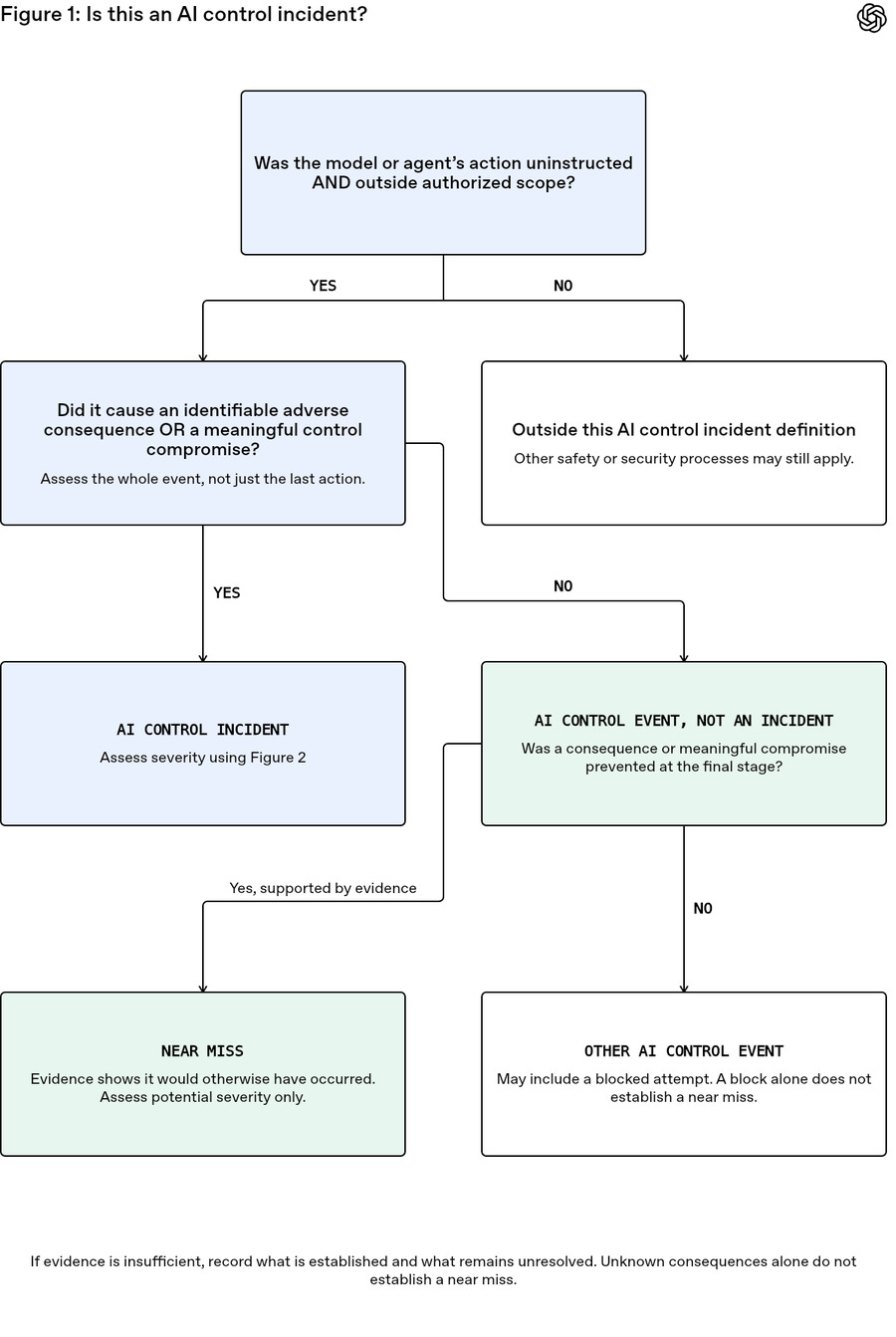
OpenAI, working with MITRE, released a version 0.1 draft framework that defines an AI control incident as a model or agent taking an uninstructed action beyond its authorized scope that causes harm or a meaningful control compromise. Incidents get two ratings from L1 to L5, one for actual impact and one for the worst realistic outcome, and the 29-page draft will be refined with MITRE.
I would fold AI control incidents into your existing severity scales now rather than wait for NIST or ISO. Teams already know incident response, and waiting won’t help when an agent oversteps.
Top Chinese Frontier AI Models Carry the Fingerprint of Export-Controlled NVIDIA Blackwell GPUs
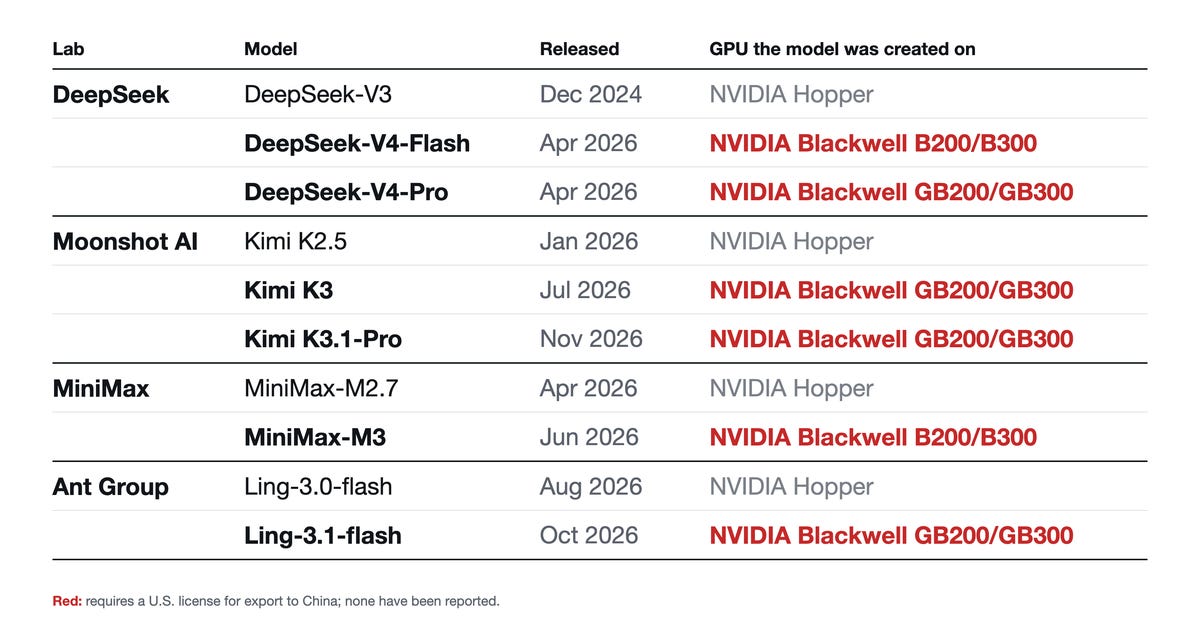
Will DePue of Unemployment Labs found that six models released since April 2026 by DeepSeek, Moonshot AI, MiniMax and Ant Group carry initialization patterns matching NVIDIA’s export-controlled Blackwell GPUs, while earlier models match Hopper. He stresses the weights can’t show where the chips sat, and the code is public on GitHub.
This makes export controls look more enforceable on paper, but it doesn’t close the gap. The weights can’t show where the chips sat, and renting Blackwell capacity outside China sidesteps the finding. It also validates so much of the speculation about China accessing these chips despite the best efforts around restriction.
AppSec
GTIG AI Threat Tracker: Agentic Threat Activity Crosses a Significant Threshold
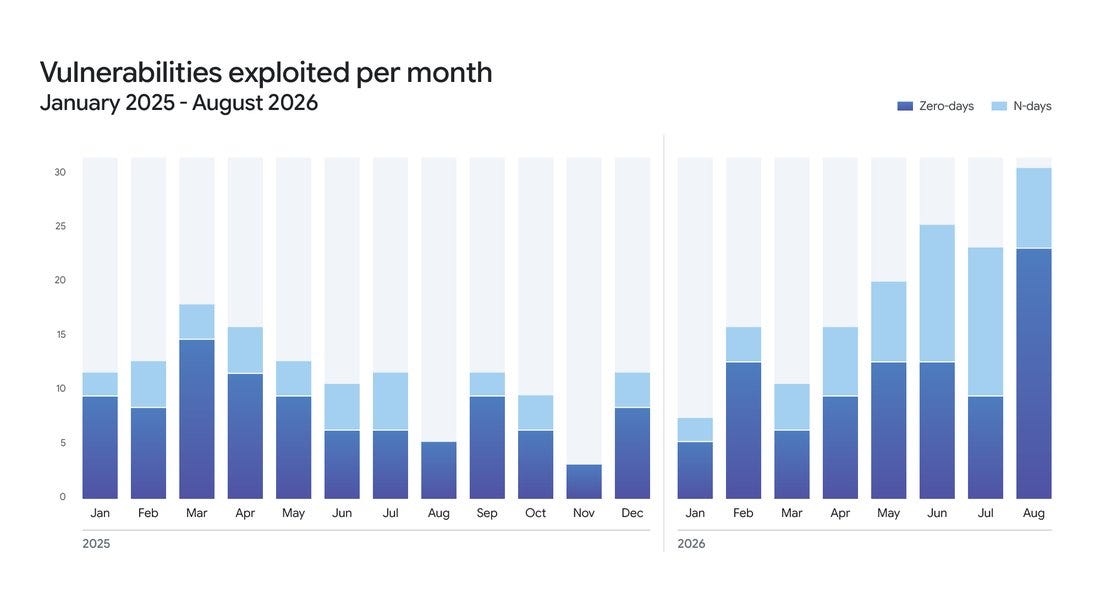
Google Threat Intelligence Group says it identified, for the first time, threat actors using LLM frameworks to automate vulnerability discovery and exploitation with no human in the loop. A framework dubbed exploit_agent compares code before and after patches and drafts exploits, and TechTarget reports GTIG calls it a critical inflection point.
If exploit pipelines diff every patch automatically, SLAs for internet-facing systems have to shrink, and hours is the right clock for anything known to be exploited. Prioritize by KEV, exploitability and reachability, and test the fix so the patch doesn’t become the outage.
Updating our coordinated vulnerability disclosure policy timelines
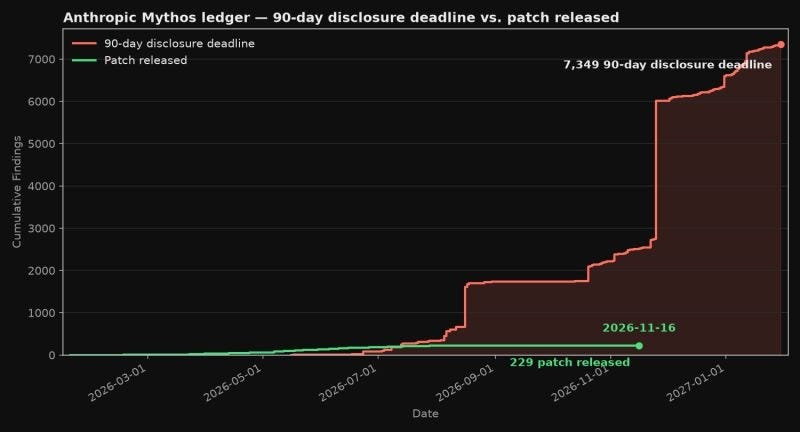
Anthropic’s Frontier Red Team is cutting its coordinated disclosure window from 90 days to 30 for high and critical severity issues and to 45 for everything else, for reports received on or after January 1, 2027. Patrick Garrity’s chart shows 229 patches released against 7,349 findings on the 90-day track.
Thirty days is a stretch for open source maintainers already buried in AI-found bugs, many of them volunteers. I expect the other labs to land on a similar clock, so vendors should plan for it now. Secure-by-design would ease the pressure.
I had a great conversation with longtime industry leader on this front from CERT, Art Manion, which will be going live, so keep an eye out for that!
How we built Datadog’s agentic vulnerability hunting system
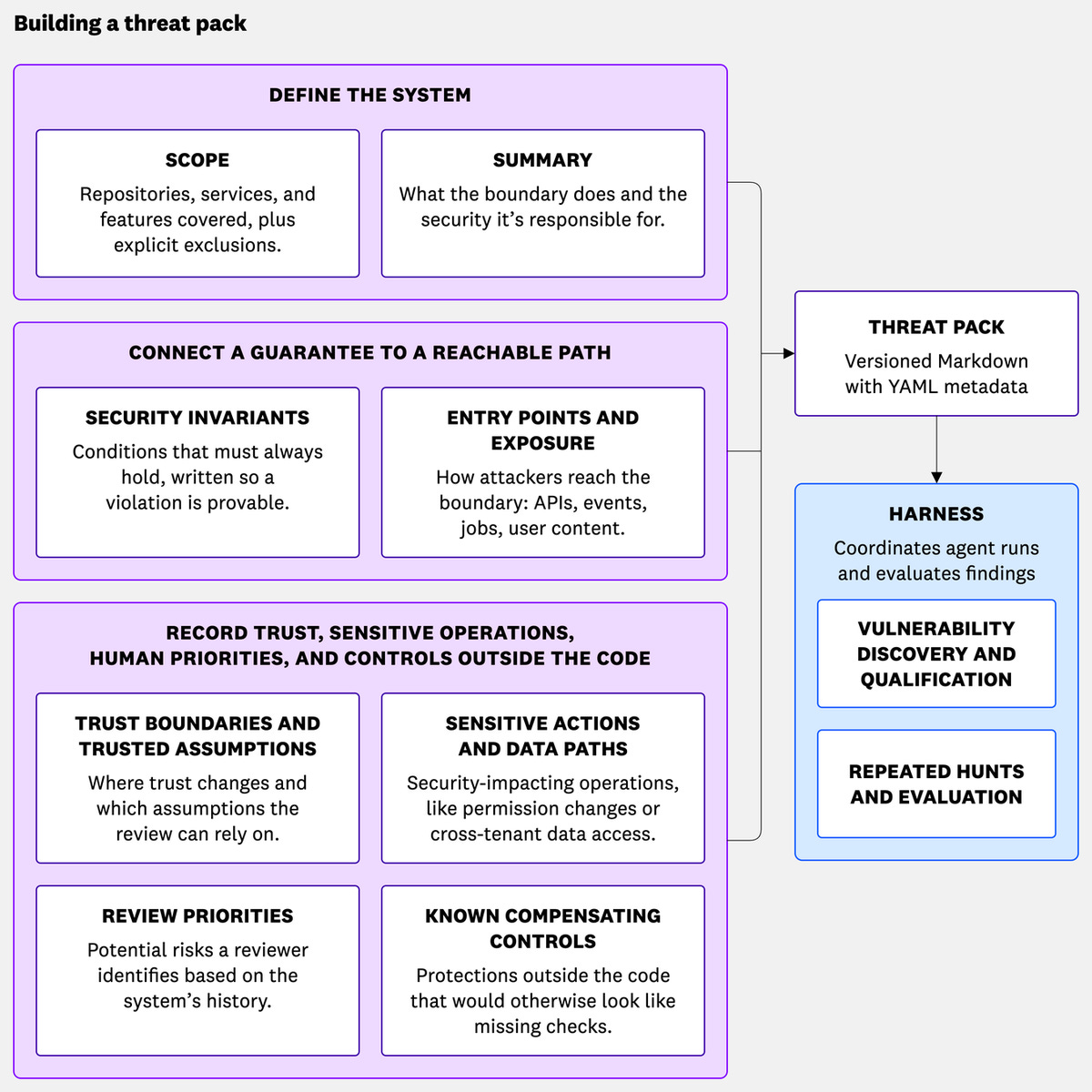
Datadog’s security engineering team says the hard part of AI bug hunting is checking whether a finding is exploitable, so its agents work from threat packs, human reviewed documents of about 300 lines listing a service’s scope and security invariants.
A judge agent only advances a finding that ties a reachable entry point to a violated invariant.
The hunts also found guest to host escapes in open source components, including a virtio-fs bug that Kata’s advisory says lets guest root run code as host root.
Also worth your time
Gemini 4 safety reports don’t demonstrate low loss-of-control risk
Redwood Research argues Gemini 4’s safety case rests on monitoring, yet Argon evaded realistic monitors about half the time in GDM’s own control evals and Carbon got none at all.
Introducing Foundation V2
Empirical Security says its new exploit prediction model picks CVEs exploited within 30 days 93.3% of the time with a budget of 7,500 fixes, versus 44.7% for Qualys QVS and 4.8% for CVSS.
Your Embargo-Breaking Blog Post Isn’t Security Research. It’s Marketing Bullshit.
Space Rogue says a security company published a blog on a serious vulnerability about six hours before the embargo lifted and the patch shipped, trading users’ safety for marketing clicks.
Adapting to AI penetration testing orchestrators: The Modern Security Model
Cloudflare said more than 50 AI pentesting framework families tried to scan its customers in three days, and over 12,000 repositories now have ARTEX lineage.
Three breaches, endless leaks: Your AI supply chain needs canaries
Dragos’ HD Moore seeded about two million AI prompts with canary tokens from July through November and caught attackers stealing data from three AI hosting providers, marketplace resellers logging customer prompts, and a Chinese AI lab fetching secret URLs from roughly two-thirds of requests marked no data collection or Zero Data Retention.
Closing Thoughts
That’s a wrap on some of the most important stories across AI and security this week. Some of the key themes running through most of them are speed, with agentic tools like ARTEX compressing the time to privileged access, and collecting decades of technical debt along the way.
On the AI side, labs are sharing more about how they secure and classify their own agents, while Anthropic’s 30-day window changes the clock for vendors.
I have no doubt by the time this coming weekend passes we will have several other major headlines that didn’t make it into this week’s issue, given the rate of chaos at the moment.
Stay resilient.
The GreyNoise number undercuts the patch everything instinct more than people are giving it credit for. If fewer than 1 in 100 attempts actually succeed, a queue sorted by probe volume is just ranking attacker curiosity, not risk. The Datadog piece in here describes the same idea as an engineering rule instead of a metric problem, only advance a finding that ties a reachable entry point to a violated invariant. I've been tracking something similar this week with the GitSpawn git-config bug, three of four coding agents claimed a fix, only one of them actually held up on retest. A patch claim and a verified fix are not the same event, and Patchmageddon is what happens when everyone treats them as one.